
Poker Hand Rankings: Complete Guide to Hold’em, Short Deck & Lowball
Hand rankings are one of the most important concepts to understand before playing poker, whether you’re at a live table or playing online poker. The strength of your poker hand shapes every decision during each betting round: when to bet aggressively, when to fold, when to play cautiously.
Most intermediate poker players know the traditional hand rankings. What many don’t realize is that these rankings change depending on the poker variant you’re playing. This guide covers the most commonly-used hand rankings in poker games, from the Texas Hold’em standard to the two types of lowball rankings. These fundamentals matter whether you play cash games or poker tournaments.
What are poker hands?
If you’re new to poker, hands are specific sets of cards that players aim to make. Most poker hands are made from five cards, but certain poker games use fewer. Badugi, for example, uses four-card hands.
Not all hands are equal. The player with the strongest poker hand in the final betting round wins the pot.
Standard hand rankings
These hand rankings are by far the most-used ones in poker. They’re present in Texas Hold’em, Omaha poker, Seven Card Stud, and other popular poker games. In community card poker games like Texas Hold’em and Omaha, players combine their hole cards with community cards to make the best hand possible.
In community card poker games like texas holdem poker and Omaha, players combine their hole cards with community cards to make the best hand possible.
2, 3, 4, 5, 6, 7, 8, 9, 10, Jack, Queen, King, Ace. For straights and straight flushes, the ace can function as either a high or low card. If used as a low card, it becomes a “one,” making A-2-3-4-5 the lowest possible straight.
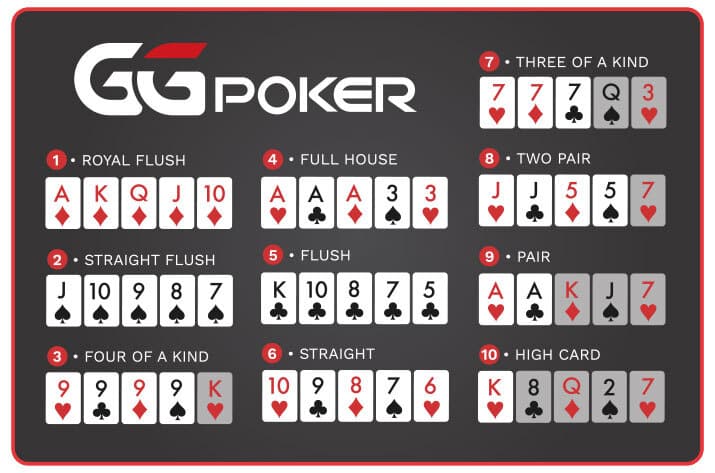
In addition to individual card rankings, particular combinations of cards can increase a hand’s strength. Here they are, from lowest to highest:
High Card – This is a poker hand without any other combinations. Its value is determined by the highest of the five cards.
One Pair – This hand contains two cards of the same rank.
Two Pair – This hand contains two different pairs.
Three-of-a-kind – This hand contains three cards of the same rank.
Straight – This hand contains five cards in consecutive order.
Flush – This hand contains five cards of the same suit.
Full House – This hand contains both a three-of-a-kind and a pair.
Four-of-a-kind – This hand contains four cards of the same rank.
Straight Flush – This hand contains five cards in consecutive order and of the same suit.
Royal Flush – This hand is the highest possible straight flush in poker, consisting of a 10, Jack, Queen, King, and Ace, all of the same suit.

Evaluating poker hands
When judging a poker hand, the combination takes precedence over individual card rankings. Any pair beats a high card hand. Any flush beats a straight. This hierarchy determines who wins the pot at showdown.
If two players have the same combination, individual card rankings determine the winner. A pair of eights loses to a pair of aces.
Five card hands like straights and flushes are valued by the highest card. A full house’s value is determined by the three-of-a-kind.
When two hands are identical, the highest kicker breaks the tie. For example, 4-4-7-9-10 beats 4-4-7-8-9.
How hand rankings affect your play
Your hand strength relative to the board determines your strategy in poker games like Texas Hold’em. Strong hands like sets or two pair play aggressively to build the pot through bets. Marginal hands play better with pot control.
In Texas Hold’em, your hole cards interact with community cards to create ranges. A paired board changes relative hand strength, as full houses become more likely. When three cards of the same suit appear, flush draws affect how you play.
Pot odds determine whether drawing hands are profitable. On a flush draw after the flop in Texas Hold’em, calculate whether the pot size justifies the bets to see another card. Against multiple opponents, drawing hands gain value competing for a larger pot.
Position affects how you play different hands. Acting last in a betting round gives you information before you decide to bet, call, or fold. This lets you play more hands profitably from late position.
These concepts apply to online poker and live games, cash games and tournaments, and understanding poker rules is essential for success. For more strategic guidance, check out basic poker strategy tips from the GGPoker School.
Short Deck poker
Short Deck is a rapidly growing poker variant that originated in Asia. The game gained international prominence through Paul Phua and Richard Yong before reaching the US and online poker platforms. This action-oriented poker game uses a trimmed deck. All cards below six are removed, leaving 36 cards instead of 52.
The condensed deck changes how you play hands. Made hands arrive more frequently, and drawing to the nuts becomes critical. Many players find Short Deck more action-packed than Texas Hold’em, with bigger pots and aggressive play.
Short Deck hand rankings
Traditional hand rankings had to be readjusted for Short Deck poker due to changed probabilities. In most Short Deck variants, flushes beat full houses since they’re harder to make with four fewer cards per suit in the deck.
Aces can still function as low cards, taking the value of five and making A-6-7-8-9 the lowest possible straight.
Hand ranking rules can vary by venue. Some games use three-of-a-kind beating a straight, while others maintain traditional rankings for these hands. Always check the specific rules before you play Short Deck. The variant has gained traction at high-stakes games and online poker rooms.

Lowball poker rankings: Ace-to-five
Lowball poker inverts traditional hand rankings. The “best” hands in standard poker become the worst in lowball. Variations of lowball rankings have become increasingly common in poker games like Razz and Badugi, available at online poker sites.
There are two primary lowball approaches: Ace-to-five low and Deuce-to-seven low. Ace-to-five, also known as California Lowball, is more popular. It ignores straights and flushes entirely and considers aces the lowest and “best” cards. Paired hands lose to unpaired ones.
The best hand in ace-to-five lowball is A-2-3-4-5 since straights don’t count. Ace-to-five is used in poker games like Razz and Hi/Lo games, where the pot splits between the strongest and weakest hands. In split-pot games, you’re often trying to scoop the entire pot with both the best high and low hands.
Lowball poker rankings: Deuce-to-seven
Deuce-to-seven, also known as 2-7 Lowball or Kansas Lowball, is the alternative lowball approach. It completely inverts traditional poker hand rankings. Straights and flushes exist in this poker variant and hurt your hand.
Aces are always considered high, making them the “worst” cards. The best hand in Deuce-to-seven lowball is 2-3-4-5-7 since aces don’t go below twos, and 2-3-4-5-6 would make a straight.
While less widespread, Deuce-to-seven is used in popular lowball poker games like 2-7 Triple Draw and Badeucy, a Badugi variation. Triple Draw has become a staple in mixed games and remains popular among high-stakes poker players. When you play these games online or live, the inverted rankings become intuitive quickly.
About the Author: Shawn Altbaum has been writing and editing in the online gaming industry since 2007, reporting live from the WSOP Main Event and conducting interviews with professional players. An active poker player, he combines industry expertise with firsthand knowledge of the games he covers. He currently serves as Global Head of Copywriting at NSUS Group, overseeing brand voice and content strategy across GGPoker and GGVegas.