GGPoker Spin & Gold Strategy

Three or six players. Random multipliers. Winner takes all. Here’s how to beat it.
Spin & Gold is GGPoker’s jackpot sit-and-go format, where a random spin before each game determines the prize pool multiplier. You might play for 2x your buy-in or spin into a life-changing 200,000x jackpot. The format is fast, aggressive, and requires a different skill set than traditional poker.
What follows: hyper-turbo fundamentals, push/fold strategy, multiplier adjustments, and bankroll management.
👉 Use Referral Code: WINBIG 👈PLAY TEXAS HOLD’EM POKER!
Understanding the Format
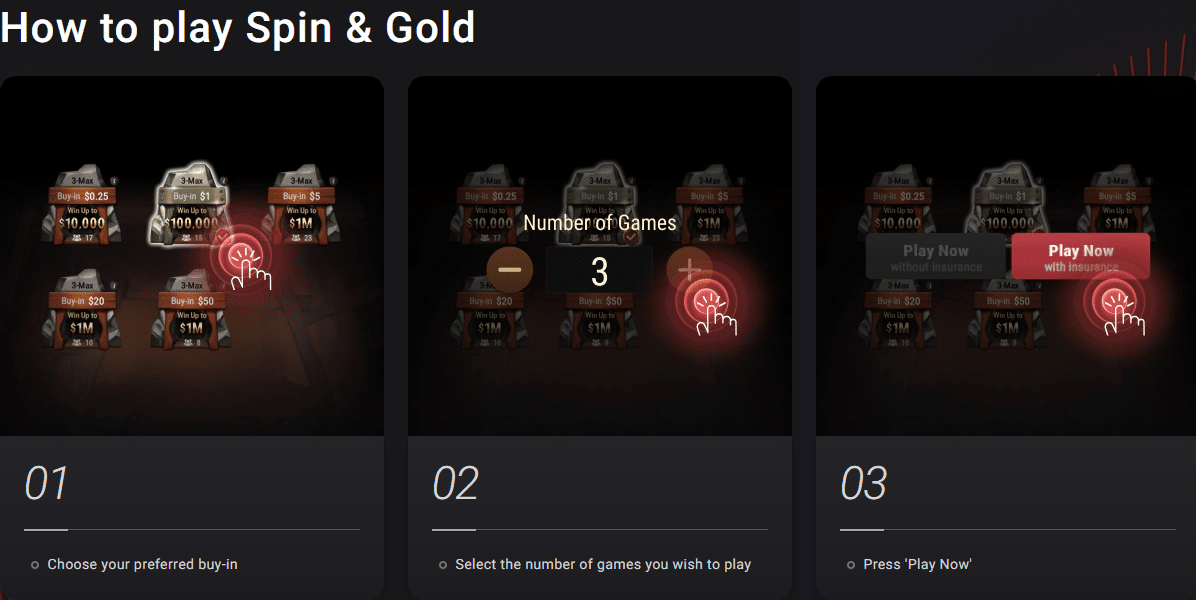
How it works:
- 3 or 6 players: You choose either a three-handed or six-handed sit-and-go
- Starting stacks: 500 chips, but increases with bigger multipliers
- Blind structure: Hyper-turbo, increasing every 3 minutes
- Random multiplier: Spun before cards are dealt (2x to 200,000x)
- Winner takes all: Standard games pay first place only (higher multipliers pay 2nd/3rd)
The hyper-turbo structure means you start with playable stacks but quickly reach push-or-fold territory. Understanding when to shift gears is essential.
Multiplier Distribution
In a 3-Handed game, most Spin & Gold games award either a 2x or 3x multiplier while in the 6-Handed version it’s 4x or 6x. Here’s the approximate distribution:
| Multiplier | Approximate Frequency | Prize (at $5 buy-in) |
| 2x / 4x | ~47.8% | $10 / $20 |
| 3x / 6x | ~44.6% | $15 / $30 |
| 4x / 8x | ~2.6% | $20 / $40 |
| 5x / 10x | ~2.5% | $25 / $50 |
| 10x / 20x | ~2.4% | $50 / $100 |
| 100x – 200,000x | ~0.1% | $500 up to $1,000,000 |
The jackpot multipliers are rare, but they’re factored into the expected value. Your long-term profit comes primarily from consistently winning the 2x and 3x games, with occasional big scores providing variance spikes.
Early Game Strategy (15+ Big Blinds)
With 25bb starting stacks, you have some room to play poker before the push-or-fold phase begins.
Opening Ranges
In the button position (small blind posts, you’re on the button), open wide:
- All pairs
- All aces
- All kings
- All queens
- Suited connectors down to 54s
- Suited gappers like T8s, 97s
- Offsuit broadways (KJ, QJ, KT)
From the small blind (acting first after the button), tighten up slightly but still attack the big blind frequently.
3-Betting
With effective stacks of 20-25bb, 3-betting puts significant pressure on opponents. Your 3-bet range should include:
- Value: AA, KK, QQ, JJ, AK, AQ
- Bluffs: A5s-A2s, suited connectors occasionally
Size your 3-bets to around 3x the open raise. This commits you to calling a shove with your value hands while giving fold equity with bluffs.
Postflop Considerations
With shallow stacks, postflop play is limited. When you do see flops:
- C-bet small and frequently on dry boards
- Check back marginal hands to control pot size
- Don’t slow play. Get stacks in with top pair or better
- Avoid tricky plays; straightforward poker works best
Push/Fold Phase (Under 15 Big Blinds)
Once stacks drop below 15bb, the game transitions to a push-or-fold strategy. Open raising no longer makes sense because you’re pot-committed to calling shoves anyway.
Push Ranges by Position
Here are approximate shoving ranges at 10bb effective:
Button (first to act):
- All pairs
- All aces
- K2s+, K7o+
- Q4s+, Q9o+
- J7s+, JTo+
- T7s+, T9o
- 97s+, 98o
- 87s, 76s
Small Blind (vs. Big Blind):
- All pairs
- All aces
- K2s+, K5o+
- Q2s+, Q8o+
- J5s+, J9o+
- T6s+, T9o
- 96s+
- 86s+, 87o
- 76s, 75s
These ranges should expand as your stack shrinks. At 5bb, you’re shoving almost any two cards from the button.
Calling Ranges
Calling all-in requires a stronger range than pushing because you’re never getting folds. Against a button shove, call from the big blind with approximately:
- All pairs 22+
- A2s+, A7o+
- K9s+, KTo+
- QTs+, QJo
- JTs
Against a small blind shove, tighten up slightly as they typically have stronger ranges than button shoves.
ICM Considerations in Paid Games
In 2x multiplier games (winner-take-all), ICM doesn’t apply: you’re playing to win, period. But in higher multipliers where 2nd and 3rd place pay, you need to consider ICM:
- Avoid marginal confrontations with the chip leader
- Apply pressure on the short stack if you’re in second
- Tighten your calling ranges when survival increases your equity
The higher the multiplier, the more important ICM becomes. In a 100x or 100,000x game, folding to level up the money can be correct even with decent hands.

Adjusting to Opponent Types
Your ranges should shift based on who you’re facing:
Against Passive/Tight Players
- Attack their blinds relentlessly
- Widen your shoving ranges significantly
- Fold to their aggression as they will usually have it
Against Aggressive Players
- Widen your calling ranges against their shoves
- Tighten your open-shoves from positions where they attack
- Let them bluff into you with strong hands
Against Recreational Players
- Value bet thinner as they tend to call too wide
- Reduce bluffing frequency
- Assume they do not understand push/fold ranges
GGPoker’s Spin & Gold pools contain many recreational players. Exploit their tendencies rather than playing GTO against everyone.
Heads-Up Play
In three-handed, once one player busts, the game becomes heads-up. This is where many players leak chips. The same theories below apply to six-handed, once 3 players bust, as in six-handed, a minimum of 2 players will get paid.
Aggression Is Essential
Heads-up with shallow stacks rewards constant pressure. From the button (small blind), you should be:
- Raising or shoving almost every hand
- Never open-limping
- Applying maximum pressure to the big blind
From the big blind, defend aggressively against button opens. Many players fold too much heads-up; make them pay for it.
Stack Size Adjustments
Heads-up push/fold ranges are extremely wide:
At 10bb, Button can profitably shove:
- Any pair
- Any ace
- Any king
- Any queen
- Most jacks
- Suited connectors and one-gappers
At 5bb, Button should shove:
- Virtually 100% of hands
If you’re not comfortable shoving wide, you’re leaving money on the table.
The Mental Game of Spin & Gold
Jackpot SNGs are high-variance by design. Your mental approach matters:
Detach from Individual Results
You will lose with AA. You will get outdrawn on the river. You will run bad for hundreds of games in a row. This is normal. Focus on making correct decisions, not on outcomes.
Volume Is Your Friend
The more games you play, the faster your results converge to your true win rate. Don’t let a bad session discourage you from putting in the volume needed for the format.
Manage Jackpot Expectations
Don’t play Spin & Gold expecting to hit the 200,000x multiplier. Play because you’re a skilled player who can profit from consistent small wins. Jackpots are bonuses, not the business model.

Bankroll Management
Spin & Gold variance is extreme. Proper bankroll management is non-negotiable.
Minimum Buy-In Requirements
| Risk Tolerance | Recommended Buy-ins |
| Conservative | 100+ buy-ins |
| Standard | 75-100 buy-ins |
| Aggressive | 50-75 buy-ins |
These requirements are higher than regular SNGs because of the prize pool variance. Even winning players experience brutal downswings in this format.
Moving Up Stakes
Wait until you have the recommended bankroll for the next level before moving up. If you take shots and lose, move back down immediately. Don’t let ego keep you at stakes your bankroll doesn’t support.
Using GGPoker Features
GGPoker offers tools that help in Spin & Gold:
Smart HUD
Even in short games, the HUD provides useful data. Watch for:
- VPIP: how often are opponents entering pots?
- Fold to steal: can you attack their blinds profitably?
- Aggression: are they passive or aggressive postflop?
PokerCraft Analysis
Review your Spin & Gold results in PokerCraft. Look for:
- Your ITM (in-the-money) percentage
- ROI at each stake level
Common Spin & Gold Mistakes
Playing Too Tight Early
Some players wait for premium hands with 25bb stacks. By the time they find aces, they’re down to 12bb and the hand is less valuable. Stay aggressive from the start.
Not Adjusting to Stack Depths
The transition from open-raising to push/fold is critical. If you’re still making 2.5x opens with 8bb, you’re making a fundamental error.
Overvaluing Hands Heads-Up
K9o heads-up at 10bb is a monster. Many players fold hands like this because they “don’t look good.” Trust the math, not your feelings.
Tilting After Bad Beats
One cooler shouldn’t affect your next ten games. If it does, take a break. Playing tilted in Spin & Gold compounds losses rapidly.

Start Spinning
Spin & Gold offers fast action and the dream of massive jackpots. But underneath the lottery element is a skill game that rewards players who understand hyper-turbo strategy.
Study push/fold ranges until they’re automatic. Practice heads-up aggression until it feels natural. Build your bankroll conservatively and put in the volume.
The jackpots are fun when they hit. But consistent profit comes from winning the games that matter most: the 2x and 3x multipliers you’ll play thousands of times. Master those, and the occasional big spin becomes icing on the cake.
About the Author: Shawn Altbaum has been writing and editing in the online gaming industry since 2007, reporting live from the WSOP Main Event and conducting interviews with professional players. An active poker player, he combines industry expertise with firsthand knowledge of the games he covers. He currently serves as Global Head of Copywriting at NSUS Group, overseeing brand voice and content strategy across GGPoker.