
Rush & Cash – GGPokers Fast Fold Game

More hands, more decisions, more profit potential—if you adjust correctly.
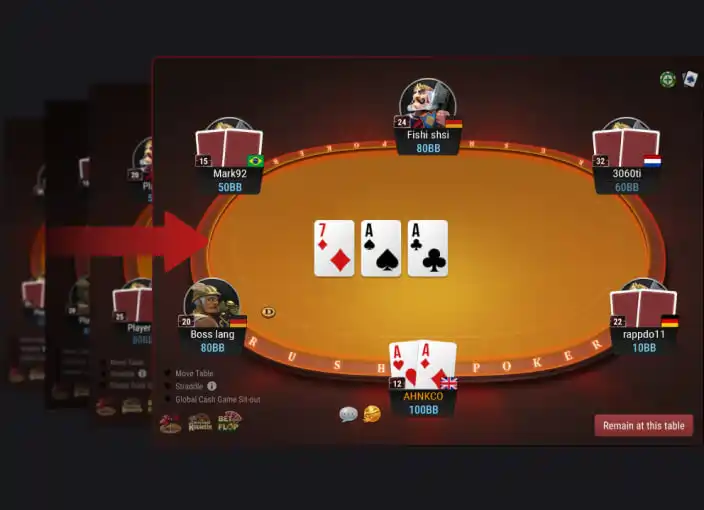
Rush & Cash is GGPoker’s fast-fold format, and it changes everything about how you should approach poker. The moment you fold, you’re whisked away to a new table with new opponents. No more waiting. No watching others tank. Just constant action.
Playing poker at this speed creates unique strategic challenges. The player pools are larger, reads are harder to develop, and the games reward a tighter, more disciplined approach than regular tables. Let’s break down how to beat Rush & Cash.
How Rush & Cash Works
Before diving into strategy, let’s ensure you understand the format:
- You’re drawn from a large pool of players, not seated at a fixed table
- When you fold, you immediately move to a new table
- The “Rush” button lets you fold out of turn and instantly get a new hand
- You can play 200-300+ hands per hour (compared to 60-80 at regular tables)
- Rush & Cash is available in No-Limit Hold’em and Pot-Limit Omaha formats
The speed factor alone makes this a fundamentally different game. More hands per hour means more opportunities, but also more chances to make costly mistakes.
Why Rush & Cash Requires A Different Strategy
Three factors change everything:
1. Reduced Player Reads
At a regular table, you might play hundreds of hands against the same opponent in a session. You learn their tendencies, their timing patterns, their emotional responses. In Rush & Cash, you might face someone once and never see them again. Or see them five times in ten hands due to random table assignment.
This means exploitative adjustments based on individual reads are less valuable. You need a fundamentally sound baseline strategy that works against dozens of unknown opponents.
2. Tighter Player Pool
Fast-fold formats attract players who want to play lots of hands without waiting. These tend to be more experienced, more serious players. The recreational crowd often prefers regular tables where they can chat, watch hands, and take their time.
The result: Rush & Cash player pools are generally tighter and more competent than equivalent stakes at regular tables.
3. Higher Volume, Lower Variance Per Session
Playing 3x more hands per hour means your results converge to your true win rate faster. Short-term variance smooths out more quickly. This is good news if you’re a winning player—your edge materializes faster.
Preflop Strategy Adjustments
Your preflop game needs to tighten up significantly in Rush & Cash. Here’s why and how:
Play Tighter from Early Position
The fast-fold button creates a psychological temptation to play marginal hands. You can always just fold and get a new one instantly, right? But this mindset leads to playing too loose because you’re impatient.
In early position, stick to premium hands:
- AA, KK, QQ, JJ, TT, 99
- AK, AQ suited, AQ offsuit
- Maybe AJ suited, KQ suited if you’re feeling frisky
That’s it. Fold everything else from UTG and UTG+1 without regret. The next hand is already coming.
Defend Your Blinds Appropriately
Because the player pool is tighter, open raises from late position are slightly more likely to be legitimate hands rather than pure steals. Adjust your blind defense accordingly—don’t call with trash hoping to outplay post-flop. You won’t have the reads to do it effectively.
From the big blind facing a button open:
- 3-bet for value: JJ+, AK, AQ
- 3-bet as a bluff (occasionally): A2s-A5s, suited connectors
- Call: Pocket pairs 22-TT, suited broadways, suited connectors, suited aces
- Fold: Offsuit junk, weak kings, random hands…you know, everything else
Size Your Opens Consistently
Without player-specific reads, varying your open sizes gives away information without gaining the benefit of exploitation. Use a consistent sizing—2.5x or 3x depending on your preference—from all positions.
The Rush Button Trap
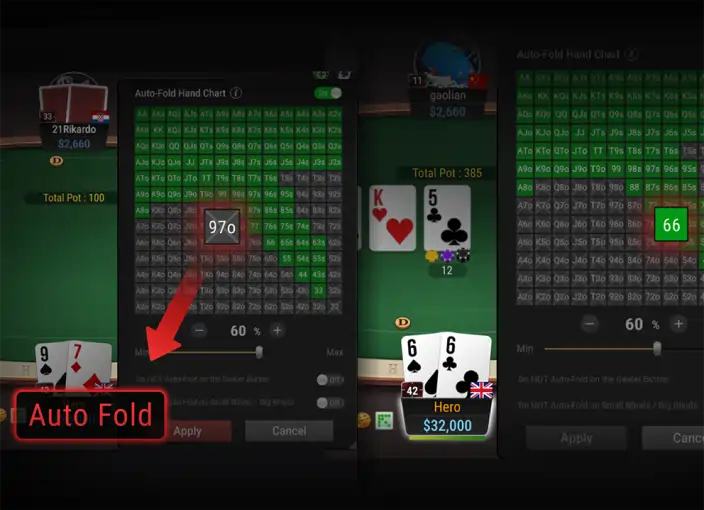
The “Rush” button is the format’s defining feature, and it’s also a trap for undisciplined players.
When you hit Rush, you fold your hand and immediately receive new cards. The problem: you’re folding out of turn, which means you’re not collecting information from the rest of the hand.
When to Use Rush
- You have absolute garbage (72o, 83o, etc.) and no positional advantage
- The pot is already large and your hand has zero equity
- You’re in early position with an easy fold
When to Wait
- You’re in the blinds and action hasn’t reached you yet
- You have a hand that could improve if several players fold
- A short stack is in late position (their range affects your decision)
- You want to note a player’s tendencies for future reference
Patience pays even in fast-fold. Don’t let the button’s convenience make you lazy.
Postflop Fundamentals
Without strong reads, postflop play in Rush & Cash becomes more about board texture and range interaction than opponent exploitation.
Continuation Betting
On dry boards (like K72 rainbow), c-bet frequently. Your preflop range should contain more kings than your opponent’s calling range, and there are few draws to worry about.
On wet boards (like Jh9h8c), be more cautious. These textures hit many calling ranges hard, and your opponents are competent enough to recognize when they have equity.
Recommended c-bet frequencies:
| Board Texture | In Position | Out of Position |
| Dry (K72r, A83r) | 70-80% | 60-70% |
| Medium (QT5, J87r) | 55-65% | 45-55% |
| Wet (Jh9h8c, 876) | 40-50% | 30-40% |
Check-Raising Defense
When you face a c-bet, develop a balanced check-raising range. Include some strong made hands, some draws, and occasionally some complete air. Without this balance, you become easy to exploit—even by opponents who’ve only seen you play a few hands.
Pot Control
With marginal hands like top pair weak kicker, lean toward pot control lines. Check back or make smaller bets. You don’t have enough information about your opponent to confidently build large pots with medium-strength holdings.

Exploiting Rush & Cash Tendencies
While individual reads are limited, you can exploit general tendencies of the Rush & Cash player pool:
Over-Folding to River Bets
Players in fast-fold formats hate calling river bets without strong hands. They know another hand is just a click away. This means your river bluffs get through more often than they should.
When the board runs out in a way that doesn’t favor your opponent’s range, consider a well-sized river bluff. Just don’t overdo it because the better players notice patterns.
Respecting Check-Raises
When someone check-raises in Rush & Cash, they usually have it. The format doesn’t encourage light check-raises because there’s no history to set up bluffs and no image to protect. If you get check-raised, proceed with caution unless you have a monster.
Attacking Excessive Limping
When you do spot a limper (rare in Rush & Cash), they’re almost always weak. Raise aggressively with your entire continuing range. These players are often recreational types who are not familiar with how fast-fold poker works.
The Cash Drop Feature
Rush & Cash includes GGPoker’s Cash Drop promotion—random prize drops that reward active players. Understanding how this works affects your strategy:
- Cash Drops award prizes to players who contribute to pots
- You don’t need to win the hand to win a drop
- Playing more hands increases your drop chances
This creates slight additional incentive to play hands rather than fold immediately. However, don’t let chasing the cash drops override fundamental strategy. The expected value of drops generally will not justify playing the less premium hands.
Bankroll Management for Rush & Cash
Higher volume means your bankroll will experience faster swings. While variance evens out over more hands, individual sessions can see significant fluctuations.
Recommended bankroll requirements:
| Stake Level | Minimum Buy-ins | Comfortable Bankroll |
| NL2-NL5 | 20 buy-ins | 30+ buy-ins |
| NL10-NL25 | 25 buy-ins | 40+ buy-ins |
| NL50-NL100 | 30 buy-ins | 50+ buy-ins |
| NL200+ | 40 buy-ins | 60+ buy-ins |
These requirements are slightly more conservative than regular tables because of the changes in the dynamics of the game and player pool.
Hand Example: Standard Rush & Cash Spot
Let’s walk through a typical hand that illustrates Rush & Cash principles:
Situation: NL50 Rush & Cash, 100BB effective. You hold A♠K♥ in the cutoff.
Preflop: Folds to you. You raise to 2.5BB. Button folds. Small blind folds. Big blind calls.
Analysis: Standard open with AK. The big blind call could be many hands—pocket pairs, suited connectors, broadways, weak aces. Without reads, we assign a reasonable defending range.
Flop: K♦ 7♣ 3♠ (Pot: 5.5BB)
Big blind checks.
Analysis: Dry board that favors our range heavily. We have top pair top kicker. This is a clear c-bet spot.
Action: You bet 2.5BB. Big blind calls.
Turn: 9♥ (Pot: 10.5BB)
Big blind checks.
Analysis: The 9 changes little. Big blind’s calling range on this flop includes hands like K9, K8, 77, pocket pairs 88-QQ, and some floats. We still beat most of this range.
Action: You bet 7BB. Big blind calls.
River: 2♦ (Pot: 24.5BB)
Big blind checks.
Analysis: Complete brick. Our hand is still strong, but pot control considerations arise. In Rush & Cash, river value bets need to target a calling range. What hands call that we beat? K-worse, maybe some stubborn pocket pairs. What hands call that beat us? Unlikely—slow-played sets would likely raise earlier.
Action: You bet 15BB. Big blind folds.
Result: Winning the pot without showdown is fine. Our value bet was well-sized and applied pressure. In Rush & Cash, don’t be upset when your value bets don’t get called—the format encourages tight folds.
Common Mistakes to Avoid
- Playing too loose – The endless stream of new hands tempts you to play marginal holdings. Resist.
- Over-bluffing – Without reads to exploit, your bluffs get called by unexploitable ranges. Be selective.
- Rushing through decisions – Speed is the format’s appeal, but take your time on important decisions. The clock isn’t that short.
- Ignoring stack sizes – Other players’ stacks matter just as much as in regular poker. Don’t auto-pilot.
- Playing too long – High-volume poker is mentally draining. Stop before fatigue affects your decisions.
Key Takeaways
- Tighten up preflop – Rush & Cash player pools are tighter and more skilled than regular tables
- Use the Rush button wisely – Don’t fold valuable information by rushing too quickly
- Play fundamentally sound poker – Without reads, exploitative plays are less effective
- Bluff rivers selectively – Players over-fold to river aggression in fast-fold formats
- Respect check-raises – They’re usually genuine strength in this format
- Maintain proper bankroll – Higher volume and tougher competition require adequate cushion
Start Playing Rush & Cash
Rush & Cash rewards patient, disciplined poker. The speed is exciting, but the strategy is fundamentally about playing fewer hands better. Resist the urge to splash around, maintain your focus over high-volume sessions, and let the volume work for you.
Load up GGPoker, find your stake level in Rush & Cash, and put these strategies to work. The action never stops—make sure your edge doesn’t either.
About the Author: Shawn Altbaum has been writing and editing in the online gaming industry since 2007, reporting live from the WSOP Main Event and conducting interviews with professional players. An active poker player, he combines industry expertise with firsthand knowledge of the games he covers. He currently serves as Global Head of Copywriting at NSUS Group, overseeing brand voice and content strategy across GGPoker and GGVegas.