
Before the WSOP: Nick the Greek, Edmond Hoyle, Corky McCorquodale and Wild Bill Hickok
Poker did not arrive fully formed. Before the bracelets, the television lights, and the World Series, the modern game was assembled slowly out of older card games, frontier saloons, and gamblers who treated a deck as a living. The four figures here never played a WSOP event, and some of them died before poker existed in any form we would recognize. Every one of them still left a fingerprint on the game, and all four sat in the very first class of the Poker Hall of Fame in 1979. This is where the story starts.
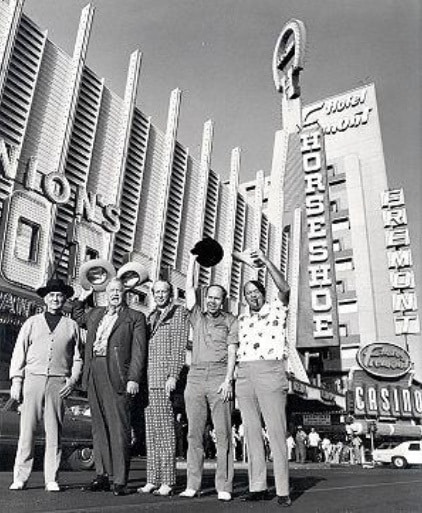
Nick ‘the Greek’ Dandolos
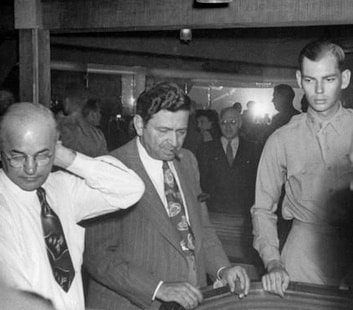
If poker has a patron saint of action, it is Nick the Greek. Nikolaos Dandolos was born in Crete in 1883, the well-schooled son of a wealthy family, and by his own account he carried a philosophy degree to America and a taste for risk that never left him. The story goes that he learned horse racing in Montreal and turned a modest allowance into half a million dollars, then lost it, then won it back. He would repeat that cycle, by his own count, more than seventy times.
What made him a legend was the scale. Dandolos gambled in numbers that stopped rooms, and he did it as a lone operator who turned down every offer to work the house side of the table. When Nevada legalized gambling in 1931, he made Las Vegas his home and one of its great attractions: a gentleman gambler who would bet a fortune on dice, cards, or a single turn.
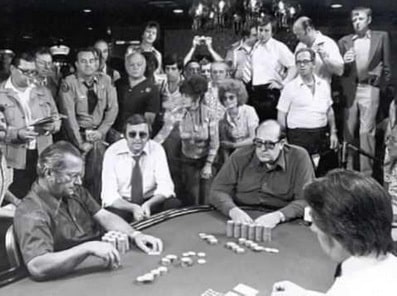
His most famous chapter is also his most doubtful. As the tale is usually told, in 1949 Dandolos sat down for a months-long heads-up marathon against Johnny Moss, arranged by Benny Binion as a public spectacle, a game later said to have inspired the World Series of Poker. Historians have since pulled it apart: Binion’s Horseshoe did not open until 1952, and the men who told the story mostly did so decades later. Something likely happened between Moss and the Greek. The rest is folklore, and it is best enjoyed as exactly that.
The folklore suits him. Dandolos is the man who supposedly walked Albert Einstein into a Vegas game and introduced him to the table as “Little Al from Jersey.” Near the end he was broke again, playing small stakes in California, and when someone asked how he could stand it after betting millions, he is said to have shrugged: “Hey, it’s action, isn’t it?” He died on Christmas Day, 1966. Thirteen years later he was a charter member of the Poker Hall of Fame, honored in its first class alongside Johnny Moss himself.
Edmond Hoyle

Edmond Hoyle never saw a hand of poker. He was born around 1672 and died in 1769, decades before the game existed, and he spent his later years in London teaching wealthy clients how to play Whist, the skill game that was the nearest thing his century had to poker. When his students kept arguing over the rules, Hoyle wrote them down.
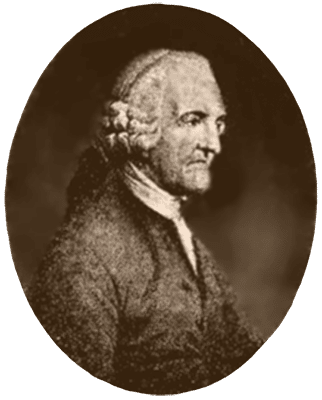
That book, “A Short Treatise on the Game of Whist,” published in 1742, made him the closest thing card playing has ever had to a lawgiver. He went on to set down rules for backgammon, chess, and other games, and his name became a synonym for authority itself. Three centuries later, “according to Hoyle” still means doing a thing properly, by the book, even for the many people who have no idea whose book it was.
His place in poker is an accident of influence rather than authorship. Hoyle never wrote a poker rule in his life; publishers simply kept his name on gaming guides long after his death, poker eventually included. But his real contribution fits the game perfectly. Hoyle treated cards as a problem of probability, strategy, and human psychology, the same three ingredients that decide every pot dealt today. It is a short walk from his Whist tables to the long history of poker that followed.
That is why a man who died two centuries before the first WSOP holds a place in the Poker Hall of Fame, a charter member of the class of 1979. He gave the games that came before poker a shared way of thinking, and poker inherited it whole.
Felton ‘Corky’ McCorquodale

Most poker history belongs to the players who won the big hands. Felton “Corky” McCorquodale earned his place by changing what was on the table. He is credited with dealing the first game of Texas Hold’em in Las Vegas, at the California Club in 1963.
Poker had been legal in Nevada since 1931, but Hold’em was not part of the mix until Corky brought it in. Born in Fort Worth in 1904, he carried the Texas game north and gave it a room to live in. From the California Club it spread quickly to the Golden Nugget, the Stardust, and the Dunes, and from there to the rest of the world. The format traveled because it was built to: it rewards reading people as much as reading cards, and it keeps everyone at the table involved.
Walk into any card room today and Hold’em is the game you will find running, and the World Series of Poker is all but synonymous with it. None of that was inevitable, and it traces back to one operator willing to spread a game he had never dealt before. McCorquodale is not remembered for a famous bluff or a bracelet. He handed the game its future, which in poker is the rarer and longer-lasting kind of legacy. He was inducted into the Poker Hall of Fame as a charter member in 1979.
Wild Bill Hickok

Wild Bill Hickok is in the Poker Hall of Fame for the way he died. James Butler Hickok was born in Illinois in 1837 and spent his life becoming a legend of the American frontier: a Union scout and spy during the Civil War, a lawman in the roughest cattle towns in Kansas, and, for one famous afternoon in Springfield, Missouri, the winner of what is often called the first recorded quick-draw duel, against Davis Tutt in 1865.
He was a genuine celebrity by the standards of his day: striking to look at, quick with a pistol, and vain enough to briefly try acting, touring in a stage show with his friend Buffalo Bill Cody before the theater bored him back to the West. As a boy, Cody had once been saved from a beating by a young Hickok, and the two stayed friends for life.
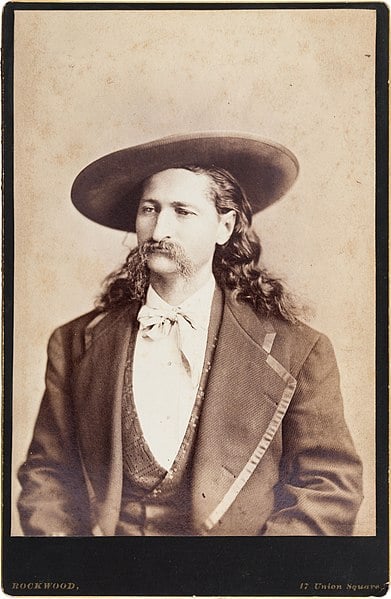
The frontier caught up with him in Deadwood. In August 1876, Hickok was playing poker in a Dakota Territory saloon when a drifter named Jack McCall walked in and shot him in the back of the head. The cards he was holding, as the legend has settled it, were two black aces and two black eights: the hand poker has called the Dead Man’s Hand ever since. The story is better than the record. The murder is documented; the exact cards were not written down until fifty years later, and the fifth card is anyone’s guess.
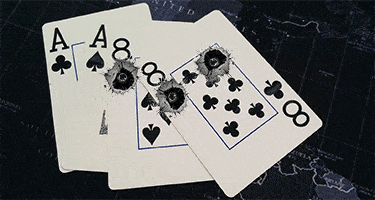
It hardly matters now. That hand is why a gunfighter who never entered a tournament is a charter member of the Poker Hall of Fame, class of 1979. Hickok gave poker its most enduring piece of iconography, and he paid the highest price for it.
Dealt From This Deck
Four men, one first class. A gambler, a rule-writer, an innovator, and a gunfighter, none of whom ever played the game as we know it, and all of whom the Poker Hall of Fame chose to remember first. Their stories are half history and half tall tale, which is fitting, because that is how poker itself came up: around tables where the truth and the bluff were never easy to tell apart. Everything that followed, the bracelets included, was dealt from this deck.
👉 Use Referral Code: WINBIG 👈PLAY NOW!
About the Author: Shawn Altbaum has been writing and editing in the online gaming industry since 2007, reporting live from the WSOP Main Event and conducting interviews with professional players. An active poker player, he combines industry expertise with firsthand knowledge of the games he covers. He currently serves as Global Head of Copywriting at NSUS Group, overseeing brand voice and content strategy across GGPoker.