
Poker’s Born Gamblers: Billy Baxter, Jean-Robert Bellande, Jason Somerville, Steve Zolotow, John Hennigan and Layne Flack
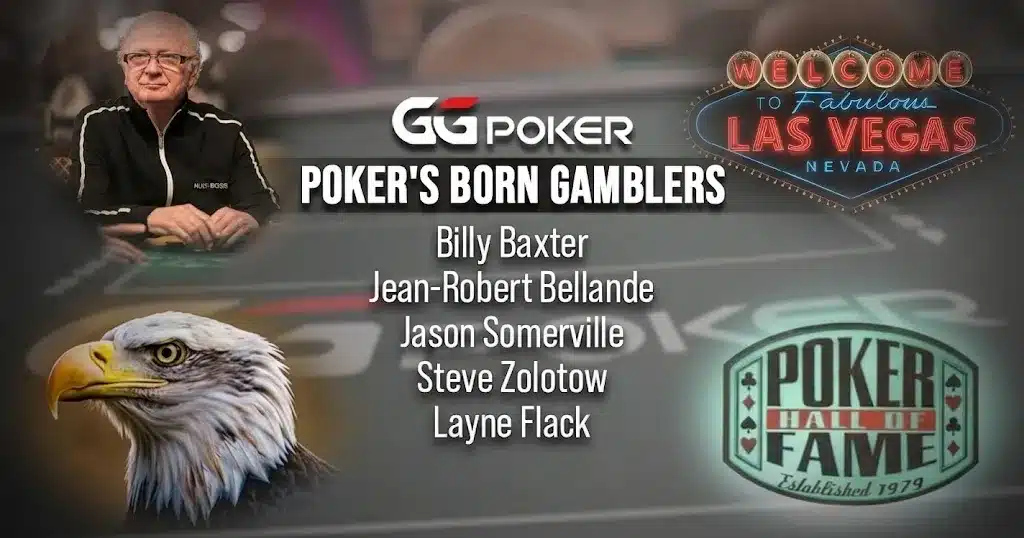
Not every great poker player arrives the same way. Some come up through study and cash-game grinding; others were gamblers first and poker players second, drawn to the table by the same instinct that pulled them toward pool halls, sports books, and gin rummy. The six men here belong to that second group — action players and specialists who treated a bankroll as something to be risked, not guarded. Between them they hold two dozen WSOP bracelets, a tax case that changed the game, one of the most influential streaming channels poker has produced, and a man who once bet he could live somewhere with nothing to gamble on.
Billy Baxter
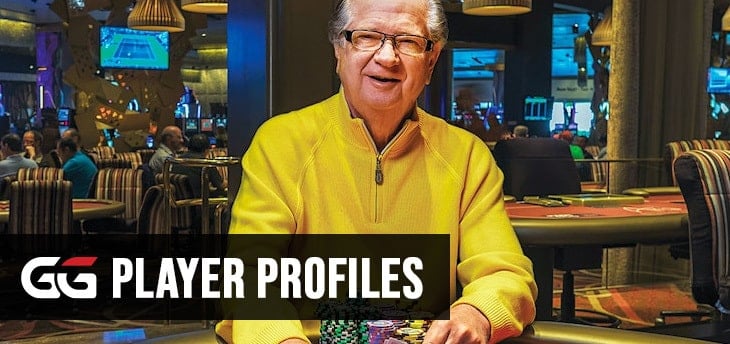
If any of these five is the prototype, it is Billy Baxter. He was a gambler long before he was a poker player — a pool hustler in Augusta, Georgia who was clearing serious money as a teenager, then a gin rummy and dice man who ran his own gambling rooms back when Georgia had some of the strictest anti-gambling laws in the country. Poker was simply the game that stuck.
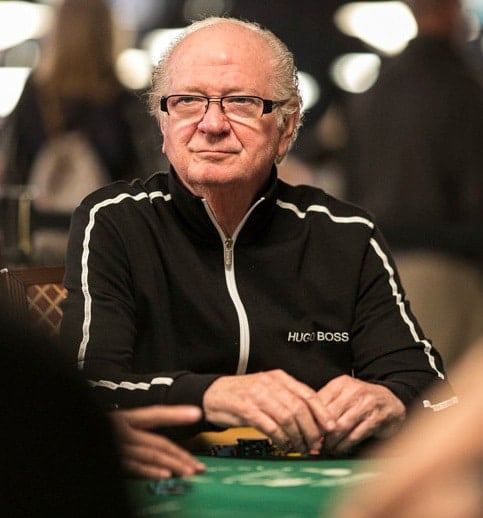
It stuck because he was very good at one corner of it. All seven of Baxter’s WSOP bracelets came in lowball and draw events, most of them No-Limit Deuce-to-Seven, a format that rewards exactly the bluffing and hand-reading he trusted. His first came in 1975 and his seventh in 2002, in Razz, and he has never quite walked away — he came within a place of an eighth bracelet in a 2023 Seniors event. His live earnings sit north of $3.4 million.
His most important win, though, came in a courtroom. In 1986 the IRS wanted to tax his poker income at the 70 percent rate reserved for “unearned” money, the kind you collect without working for it. Baxter argued that grinding at the table was work, no different from a golfer’s, and he beat them — a decision that reclassified poker winnings as earned income and quietly changed the economics of playing for a living. Sports Illustrated called him the Robin Hood of Poker.
He was also the money behind one of poker’s great comebacks, staking his friend Stu Ungar in the 1997 Main Event that Ungar famously won. Baxter was inducted into the Poker Hall of Fame in 2006.
John Hennigan
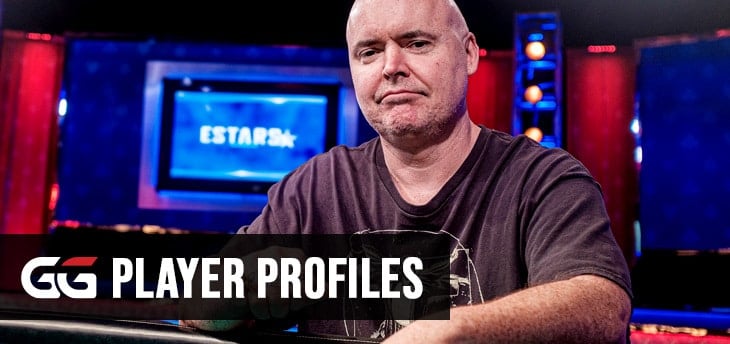
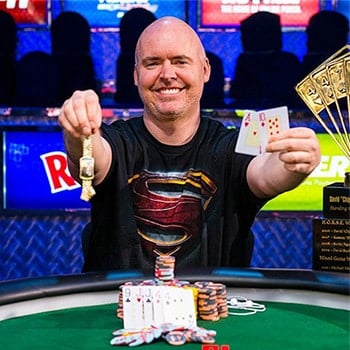
If Baxter made his name in the games away from the spotlight, John Hennigan made his living there. “Johnny World” — the nickname comes from his readiness to bet on anything in the world — is first and last a cash-game player, a mixed-game specialist who treats tournaments as something to do between the games that actually matter to him. When he won the 2016 deuce-to-seven lowball championship, he admitted he had only registered at midnight because he was “out of gas in the cash games” and needed to kill time. He then outlasted a field that included Daniel Negreanu.
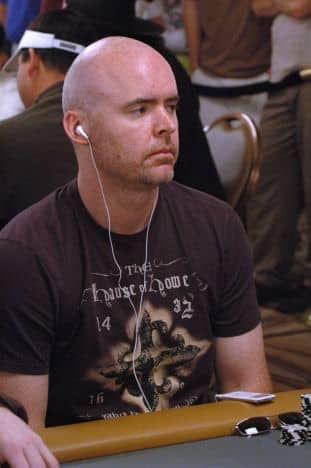
Before poker there was pool. Raised in Philadelphia, Hennigan was a professional pool player known on the billiards circuit as “Cornflakes,” and he came to cards the way a gambler does — looking for something else to bet on when he could not get a game. Poker stuck, and the same instinct that made him a road-tested hustler made him one of the most feared cash-game players alive. Peers like Daniel Negreanu and the late Gavin Smith have called him the best they ever faced.
The record backs up the reputation. Hennigan has won seven WSOP bracelets across a spread of games — HORSE, Limit Hold’em, deuce-to-seven lowball, seven-card stud, and dealer’s choice, the most recent of them in 2024 — along with a 2007 WPT Borgata Winter Open title worth a little over $1.6 million. His signature win came in the 2014 $50,000 Poker Players Championship, poker’s toughest mixed-game test, where he beat the game’s best for $1,517,767. His live earnings sit close to $10 million, and the Poker Hall of Fame inducted him in 2018.
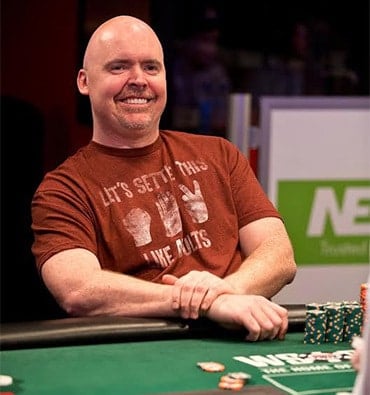
But the story that captures him best is not a trophy. Early on, a group of players bet him $50,000 that he could not move to Des Moines, Iowa — a city with no casino, no card room, nothing to gamble on — and simply live there for six weeks. Hennigan took the bet, flew out, and lasted two days before he paid up and caught the first flight back to Las Vegas. It is the perfect Johnny World story: the one wager he could not stomach winning was the one that asked him not to gamble at all.


Jean-Robert Bellande
Jean-Robert Bellande — “Action Bob” to most of the poker world — built his name on the opposite of Baxter’s quiet specialty. He plays loud and aggressive, the kind of table presence railbirds remember whether or not they remember the hand.
His route in was unusual. Born on Long Island to Haitian immigrant parents, he moved to Taiwan at five and grew up fluent in Mandarin — one of three languages he speaks, alongside French and English — with a marketing degree that probably explains how instinctively he has always managed his own brand. Poker found him almost by accident: a win at a California pool hall sent him to the Bicycle Casino, and the game took over from there.
The climb was not smooth. His early losses were as big as his later scores, and for years he was better known as a personality than a winner — including a run on Survivor: China in 2007, where he lasted until the eighth vote and sat on the jury. What kept him relevant was that he absorbed the losing stretches as readily as the winning ones, which in a high-variance game is the actual skill, not a footnote.
The results eventually caught up to the reputation. He finally broke through for his first WSOP bracelet in 2018, in a $5,000 No-Limit Hold’em event, the title that had eluded him for more than a decade. His live tournament winnings now sit near $5 million.
Jason Somerville

Jason Somerville did as much as anyone to turn poker into watchable content. Known online as “JCarver,” he was a genuine tournament player first — he won a WSOP bracelet in 2011, taking a $1,000 No-Limit Hold’em event out of a 3,175-runner field for nearly half a million dollars — but his lasting mark came through a camera rather than a card.

His channel, Run It Up, arrived on Twitch before poker was a fixture there, and it worked because Somerville could narrate his own thinking out loud while he played, turning a session into a lesson you did not notice you were taking. He helped bring World Series of Poker coverage to Twitch for the first time and once streamed for more than seventy straight days, a stretch that said a lot about how hard he was willing to work for an audience.
He also used the platform for something larger than strategy. In 2012 he came out as gay, the first high-stakes male pro to do so openly — a decision that mattered well beyond his own career, and one that made the game a little more welcoming than he found it.
His live earnings run close to $4 million, but the number undersells him. Somerville’s real contribution was the community he built and the standard he set for what poker content could be.
Steve Zolotow
Steve Zolotow — “The Bald Eagle” — came at gambling as something to be solved rather than gambled on, years before that became the standard way to think about it. His early money came from sports betting, where he used some of the first computer models to handicap games, and from blackjack, where he counted cards. Both are beaten with math and discipline rather than nerve, and that habit of mind carried straight into poker.

He learned the game at the Mayfair Club, the New York room that also produced Erik Seidel and sharpened Stu Ungar. The games there were hard on purpose — when everyone around you is that good, you improve or you go broke — and a lot of the strategic thinking that is standard now was worked out by that group while most of the poker world was still playing on feel.
Zolotow’s tournament results came steadily rather than in a rush. His first WSOP bracelet arrived in 1995 in Chinese Poker, a game obscure enough that winning it told you how widely he had studied; his second came in 2001 in Pot-Limit Hold’em. Two bracelets across two eras, from a player whose edge was never natural talent so much as a willingness to keep doing the work — he spent the 2020 shutdown the way he had spent his career, grinding through books and training sites rather than taking the time off.

Layne Flack

Layne Flack earned the nickname “Back-to-Back” the hard way — by winning two Legends of Poker events on consecutive days at the Bicycle Casino in 1999 — and then spent the next decade making it look like a description rather than a coincidence.

Raised in Rapid City, South Dakota, Flack learned cards at his grandparents’ house and took a job at a casino before deciding the tables were more interesting than the paycheck. He learned fast, partly under the guidance of Johnny Chan and Ted Forrest, two of the sharpest players of the era, and the results came in pairs. He won two WSOP bracelets in 2002 and two more in 2003, across No-Limit Hold’em, Omaha Hi-Lo, and Limit Hold’em — range that a lot of specialists never manage.
By the end he had six bracelets and a reputation as one of the most naturally gifted, and most watchable, players of his generation. He was also, by his own account, a genuine gambler in the old sense, which is part of why he belongs here alongside Baxter and Bellande rather than with the pure grinders.
Flack died in July 2021 at 52. The poker world inducted him into its Hall of Fame the following year, the sole member of the Class of 2022 — a fitting send-off for a player who spent twenty years making the hardest game look like the most fun anyone at the table was having.
Cut From the Same Cloth
Six different players, one shared instinct. Baxter, Flack, and Hennigan were gamblers who happened to be brilliant at poker; Zolotow was an analyst who beat several games before this one; Bellande and Somerville turned personality into a career of its own. What ties them together is not a playing style or an era — it is that each of them came to the table looking for action, and found a way to make it last.
👉 Use Referral Code: WINBIG 👈PLAY NOW!
About the Author: Maury Orton is a poker writer and editor contributing to GGPoker. He focuses on clear, reliable explanations of the game, drawing on years of experience in online poker media and digital publishing.