
Poker Glossary – O & P
Welcome to the GGPoker Poker Glossary — your complete reference for poker terms and concepts. Use the jump links below to navigate, or browse the full list alphabetically.
0-9 & A | B | C | D | E-F | G-H | I-L | M-N | O-P | Q-R | S | T | U-W
Ocean Rewards | Offsuit | Omaha | Omaha Hi/Lo | Omaholic | On the Button | On Tilt | One-Gap | One-Outer | Open | Open-Ended Straight Draw | Open Limp | Open Shove | Option | Orbit | Outdraw | Out of Position | Outs | Overbet | Overcall | Overcard | Overlay | Overpair | Paint | Pair | Pass | Passive | Pat | Pay Off | Peel | Penny Ante | Pineapple | Pips | Play the Board | Pocket | Pocket Pair | Pocket Rockets | PokerCraft | Poker Face | Polarized | Position | Position Bet | Post | Pot | Pot Committed | Pot Control | Pot Limit | Pot Odds | Pre-Flop | Premium Hands | Price | Pricking | Prize Pool | Probe Bet | Progressive Bounty | Protecting | Protected Pot | Purse | Push | Put On
Ocean Rewards |
GGPoker’s Loyalty Program where players earn rewards worth up to 80% cashback. See GGPoker’s promotional section for more details. |
Offsuit |
Cards that are of different suits. Opposite of Suited. |
Omaha |
A flop game very similar to Texas Hold’em with two key differences. First, each player is dealt four hole cards instead of two. Second, players must use exactly two of hole cards and three community cards to make their best hand. |
Omaha Hi/Lo |
A split-pot variant of Omaha in which half the pot is awarded to the high hand, as normal, and half the pot goes to the low hand if there’s a qualifying low of 8 or better. Players can use different hole cards for the high and low, as long as they are using exactly two from their hole cards to make each hand. |
Omaholic |
GGPoker’s daily Omaha tournament series, running around the clock at 40 minutes past every hour. Buy-ins suit every bankroll, with prize pool guarantees ranging from $100 to $10,000. Visit the Omaholic tournament page for the current schedule. |
On the Button |
See Button |
On Tilt |
Playing in a compromised mental state, usually after a bad beat or a run of losses, where decisions are driven by frustration rather than sound reasoning. |
One-Gap |
See Gap Hand. |
One-Outer |
A drawing hand that has only one possible card in the deck which will turn it into a winning hand. |
Open |
To make the first bet or raise in a betting round, when every other player before you has folded or checked. |
Open-Ended Straight Draw |
A straight draw that can be completed at either end, giving 8 outs total. Also known as an Outside Straight Draw or Double-Ended Straight Draw |
Open Limp |
Entering a pot preflop by calling the big blind rather than raising, when no one else has entered before you. A passive move that gives everyone behind you better odds to see the flop cheaply. |
 |
|
Open Shove |
Moving all-in as the first aggressive action preflop, with no prior limps or raises in the pot. Distinct from a reshove (shoving over existing action) or calling off an all-in. |
Option |
During pre-flop action, it is the right to raise held by the big blind when the action comes back to them unraised. ‘Your option’ is generally what the dealer will say when it’s the BB’s turn to act in that spot. |
Orbit |
One complete rotation of the table, in which every player has acted from each position once. |
Outdraw |
To improve a previously weaker hand and beat an opponent who initially held the stronger one. |
Out of Position |
Acting before your opponent(s) on a given street, forcing you to commit to a decision without seeing what they’ll do. Considered a disadvantage due to the missing information. |
Outs |
The cards remaining in the deck that would improve a player’s hand to a likely winner. |
Overbet |
A bet that exceeds the size of the pot. Most standard bets range from 33% to 100% of the pot; an overbet goes beyond that.Overbets tend to be polarized, made either with very strong hands or as bluffs. |
Overcall |
A call made after one or more players have already called the same bet. |
Overcard |
A card ranked higher than another card or pair it’s being compared to. This can mean a board card higher than your pocket pair (holding 8-8 on a K-7-3 flop, the King is an overcard to your pair), or an unpaired hole card higher than every card on the board (holding A-K on a Q-7-2 flop gives you two overcards). |
Overlay |
The amount by which a tournament’s guaranteed prize pool exceeds what the buy-ins actually raised. The house covers the difference, which benefits players since the prize pool is bigger than the field’s own contributions |
Overpair |
A pocket pair that ranks higher than every card on the board. Holding Queens on a 9-6-3 board gives you an overpair. |
Paint |
A face card. |
 |
|
Pair |
Two cards of the same rank. |
Pass |
A term for taking no action. It can be used to mean checking or folding. |
Passive |
A playing style that leans on checking and calling rather than betting and raising. Passive play gives up initiative and makes it easier for opponents to control the size and direction of the hand. |
Pat |
A completed hand that does not require any additional cards or draws to improve, usually used in draw games. |
Pay Off |
To call a bet, usually on the river, even though you suspect you’re beaten. Getting paid off means your opponent called when you had the best hand. |
Peel |
1) To call a bet with a drawing hand, hoping to hit your draw on the next card. 2) To lift and look at your hole cards, or to describe a card arriving on the turn or river. |
Penny Ante |
A game played for very small stakes, often just for fun. Also used casually to describe anything of little financial consequence. |
Pineapple |
A Hold’em variant where each player is dealt 3 hole cards and discards one before the flop, unlike Crazy Pineapple, where the discard happens after the flop. This gives Pineapple marginally stronger average hands than standard Hold’em. GGPoker’s Flip & Go tournaments use this format during the Flip Stage. |
Pips |
1) The small suit symbols repeated on a numbered card that also indicate its rank, since the number of pips matches the card’s value. 2) As a verb, to be ‘out pipped’ means to lose to a hand that beats yours by the smallest possible margin, such as a pair of Queens losing to a pair of Kings |
Play the Board |
When a player’s best possible hand at showdown is the board itself. |
|
|
See Hole Cards |
Pocket Pair |
A starting hand where both hole cards are the same rank. Pocket pairs range from 2-2, the lowest pair, to A-A, the highest pair. |
 |
|
Pocket Rockets |
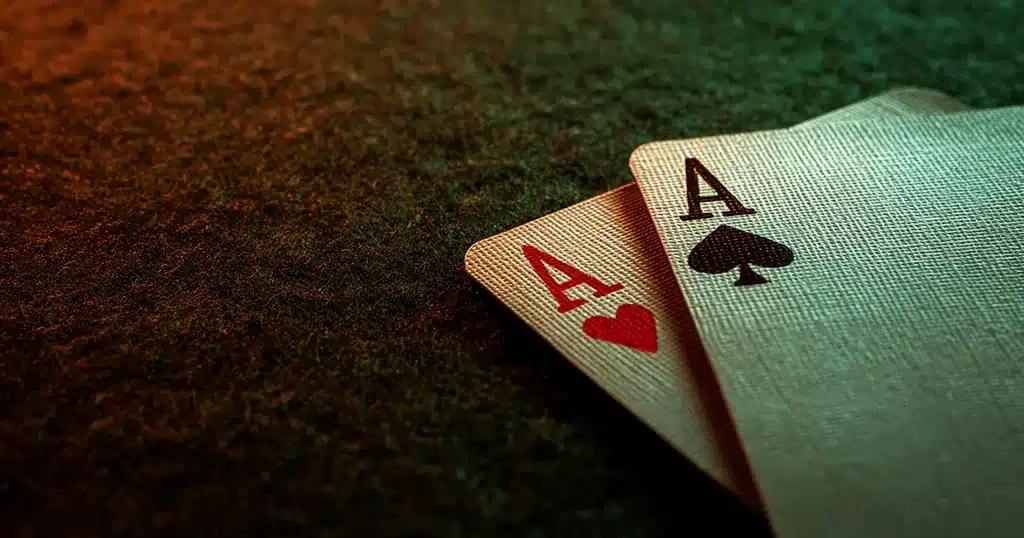
A starting hand consisting of two Aces. Also called: Bullets, American Airline, Snake Eyes and more. |
PokerCraft |
GGPoker’s built-in analysis tool. Players use it to review hand histories, track performance statistics, and identify leaks in their game. |
Poker Face |
The practice of controlling your expression, words, and demeanor at the table to avoid revealing information about your hand or intentions. It doesn’t require being expressionless, some players stay silent and neutral, while others talk constantly, but either approach works only if it’s consistent and doesn’t leak real information. |
Polarized |
A range split between strong hands and bluffs, with little or nothing in between. Often associated with large bet sizes, though the term describes the range itself, not the bet size. |
Position |
A player’s seat at the table relative to the dealer button, which determines the order in which players act during a betting round. Acting later gives players more information to better make decisions. |
Position Bet |
A bet made because of positional advantage rather than hand strength, betting because you’ll have leverage acting last on future streets, regardless of what cards you actually hold. |
Post |
To place the required blind chips into the pot. You post the small blind, post the big blind, or post a missed blind when rejoining the table. |
Pot |
The total amount of all the players’ bets in a given hand, awarded to the winning hand or split among winners in certain formats. |
Pot Committed |
A situation where the pot odds make calling correct regardless of hand strength, because so much has already been invested that folding would forfeit more equity than continuing risks. |
Pot Control |
A deliberate approach to keeping the pot small when your hand strength relative to your opponent’s range is uncertain, typically by checking or calling rather than betting or raising. |
Pot Limit |
A betting structure where the maximum raise equals the current pot, plus all bets already made this round, plus the amount needed to call. This causes pots to grow geometrically with each round of action. Pot-Limit Omaha (PLO) is the format most associated with this structure. |
Pot Odds |
The ratio of the amount of money in the pot to the amount of money needed to call the current bet. If the pot holds $100 and it will cost you $20 to call, the pot is laying you 5-to-1 odds. |
 |
|
Pre-Flop |
The phase of a hand after players receive their hole cards but before any community cards are dealt. All pre-flop decisions, fold, call, or raise, happen before the board is visible. |
Premium Hands |
The best starting hands in Poker. High pocket pairs and suited connectors, such as AA, KK, AKs, KQs. The definition of a premium hand may vary slightly, depending on a player’s range and position at the table. |
Price |
The amount necessary to call in order to stay in a hand. |
Pricking |
A form of cheating in which a player attempts to mark cards with their fingernail or other sharp tool. |
Prize Pool |
The total prize money available in a tournament, distributed among the top finishers. |
Probe Bet |
A bet made on the turn or river by the out-of-position player, after the in-position preflop aggressor checked back the previous street instead of continuation betting |
Progressive Bounty |
A variation on traditional bounty tournaments. In GGPoker’s Progressive Knockout (PKO) tournaments, each player has a bounty on their head. When you eliminate a player, you receive half of their bounty instantly as cash, and the other half is added to your own bounty, making you a bigger target for the rest of the field. |
Protecting |
A bet made with a strong but vulnerable hand, such as top pair on a drawy board, to charge opponents with draws rather than letting them see a free or cheap card. |
Protected Pot |
A pot that’s difficult to bluff because too many players have committed significant chips. With multiple players deep in a hand, the likelihood that at least one holds something strong makes a pure bluff too costly. |
Purse |
See Prize Pool |
Push |
See All-In |
Put On |
To assign a likely hand or range to an opponent based on how they’ve acted – their bet sizing, timing, and tendencies. Putting someone on a hand is an educated guess informed by everything you’ve observed. |
👉 Use Referral Code: WINBIG 👈PLAY NOW!
About the Author: Shawn Altbaum has been writing and editing in the online gaming industry since 2007, reporting live from the WSOP Main Event and conducting interviews with professional players. An active poker player, he combines industry expertise with firsthand knowledge of the games he covers. He currently serves as Global Head of Copywriting at NSUS Group, overseeing brand voice and content strategy across GGPoker.