
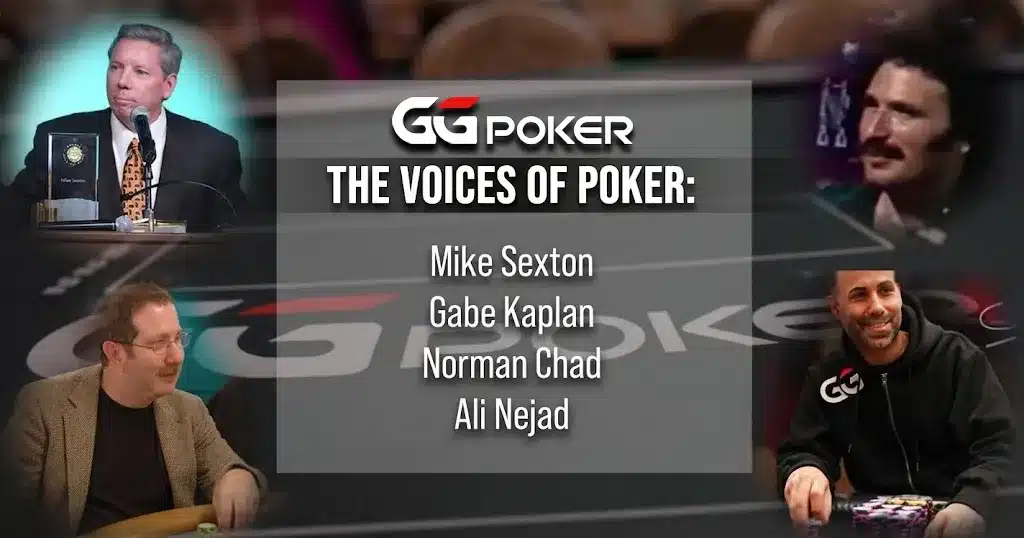
The Voices of Poker: Mike Sexton, Gabe Kaplan, Norman Chad and Ali Nejad
The people who found poker in the boom years didn’t just watch it. They played. They put in their own hours at the online tables, then turned on the television late at night to see how it was really done. And what stuck with them from those broadcasts, more than any single hand, was a voice.
That sound was built by people. The four men here spent their careers in the space between the felt and the living room, and each of them changed how the rest of us hear poker. One was called its ambassador. One came to it from a sitcom classroom. One made a punchline out of a bad beat. One still does the job today, for a new kind of show.
Mike Sexton, the Ambassador Who Meant It
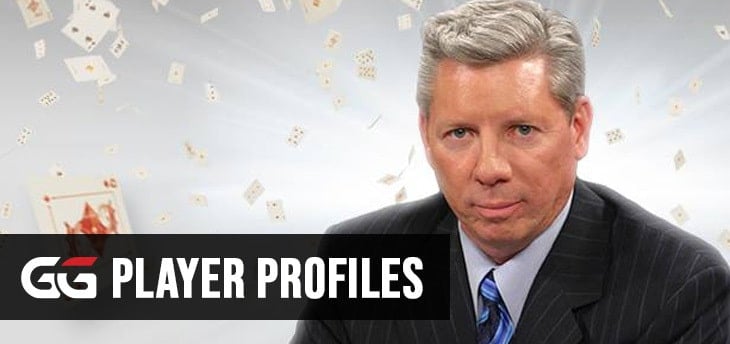
Some nicknames are marketing. “The Ambassador of Poker” was just the truth, worn in.
Michael Richard Sexton was born on September 22, 1947, in Shelbyville, Indiana, to a pair of ballroom dance teachers. He and his brother learned to dance, which made them gymnasts, which earned them athletic scholarships to Ohio State. He came out with a degree in public recreation and a joke he told for the rest of his life: that poker had been his real major. A friend named Danny Robison had put the cards in his hands at thirteen.
After Ohio State he served as a paratrooper in the 82nd Airborne, sold a little on the side, and watched his poker winnings quietly overtake his paycheck. He moved to Las Vegas in 1985. Four years later he won the only World Series of Poker bracelet he would ever need, taking the $1,500 Seven Card Stud Split and its $104,400 first prize. The résumé filled in around it: 72 WSOP cashes, a World Poker Tour title, more than $6.7 million in tournament earnings. In 2006 he won the WSOP Tournament of Champions and its million-dollar prize, beating Daniel Negreanu heads-up.
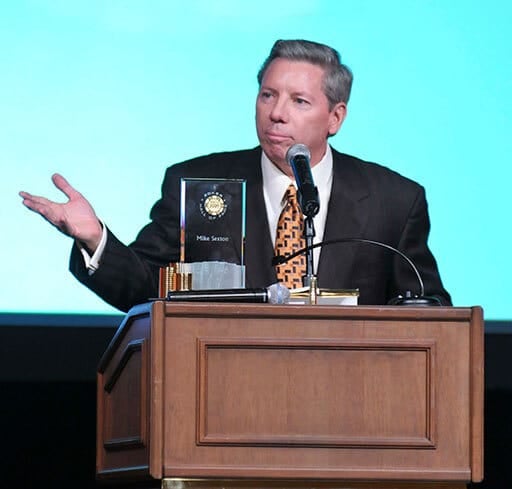
Then he gave a lot of it back. Sexton donated half of his post-tax 2006 winnings to five charities and pledged to keep doing it, co-founded the nonprofit PokerGives, and picked up a Patriot Award from Paralyzed Veterans of America along the way. The scandal-free record wasn’t an act. It was the whole point of him.
His largest contribution, though, came with a microphone. When Steve Lipscomb built the World Poker Tour, he had one name in mind for the anchor chair. “There was only one voice that could be the anchor for that show,” Lipscomb later said. “And that was Mike.” Paired with Vince Van Patten, Sexton called the WPT for fifteen seasons and became the sound of the boom for millions of new fans. He was good enough at the game he was describing to win a WPT title himself, taking Season XV Montreal: commentator and champion of the same tour.
The Poker Hall of Fame inducted him in 2009, setting him beside Stu Ungar, Johnny Moss, and Doyle Brunson. In 2017 he left the booth to chair partypoker, and said the two best jobs in poker had both been his. On July 21, 2020, the WPT Champions Cup was renamed in his honor.
“To have the WPT Champions Cup named in my honor and be part of the experience for all WPT champions moving forward is truly the highest peak in my 40 years in poker.”
He died weeks later, on September 6, 2020, after a fight with prostate cancer. It is genuinely hard to picture the televised game without him, because for so many people he was the televised game.
Gabe Kaplan, From the Classroom to the Cash Game

Most people who know Gabe Kaplan’s face don’t know he was a card player first.
He was born in Brooklyn in 1945 and learned the game where a lot of New Yorkers his age did, in the pool halls, in the low light, reading the man across the table as carefully as the cards. He was good. Good enough to make a living at it. And then, in the early 1970s, he walked away from the felt for the least likely second act imaginable: stand-up comedy, built on the Brooklyn kids he’d grown up around.
The act worked, and in 1975 it turned into a starring role. As teacher Gabe Kotter, riding herd on a classroom of misfits called the Sweathogs, Kaplan anchored “Welcome Back, Kotter” and became a household name. The deadpan that had served him at the poker table served him just as well delivering a punchline to camera.

But he never really left the game. Kaplan kept playing throughout his acting career, and when televised poker needed a face who could talk to a mainstream audience without losing the players, he was the obvious choice. He hosted and provided commentary for “High Stakes Poker” across its original run and, years later, its revival, still one of the highest-rated poker programs ever made, a show that put the biggest cash-game names in America on television and trusted the audience to keep up. Kaplan was the bridge between the two rooms he’d always lived in.
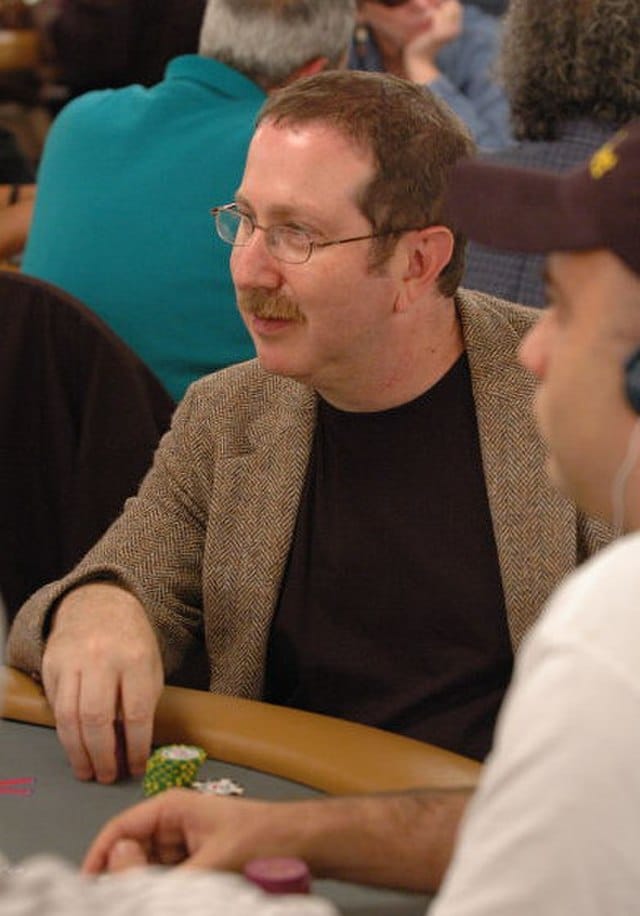
Norman Chad and the Art of the Bad Beat
Every other voice on this list wants you to respect the game. Norman Chad wants you to laugh at it, and somehow that made people respect it more.
He came up in Washington, D.C., a sportswriter by trade, and for decades he has written a syndicated column called “Couch Slouch” that runs in the Washington Post and beyond. It was sharp and self-deprecating, he mined his own failed marriages for material, and it carried a running feature, “Ask the Slouch,” that paid readers a princely $1.25 for a chosen question. The column told you everything you needed to know about the commentator he’d become: a serious mind that refused to take itself seriously.
On the ESPN broadcasts of the World Series, Chad built a private language for the game. A weak holding was “squadoosh.” A player sent to the rail had been “whamboozled.” The words sound like jokes, and they are, but they also do real work: they name the small humiliations of poker in a way the standard vocabulary never could. Learn a little of the game’s actual terminology and you appreciate how neatly his slang slots in beside it.

Underneath the shtick was a genuine reader of the game and its people. Chad could dissect a hand as cleanly as anyone in the booth; he just preferred to make you smile while he did it. For fans who found the World Series through Daniel Negreanu and the boom-era ESPN coverage, his voice is inseparable from the memory. He belongs in the same broadcast tradition Mike Sexton and Gabe Kaplan built.
Ali Nejad and the Voice of the Next Show
The booth doesn’t sit empty. It gets handed down, and one of the people holding it now came to broadcasting the same way Sexton and Kaplan did: as a player first.
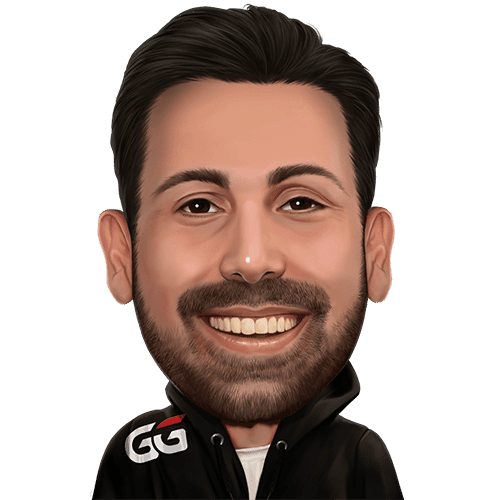
Ali Nejad was born in Tehran on August 25, 1978, and raised in the United States. He was a serious tournament player before he was ever a host. Multiple WSOP appearances, the kind of results that earn a table’s respect. And it turned out the skills transferred better than anyone expected. The patience, the read on an opponent, the ability to explain a decision without condescending to it: that is a commentator’s toolkit, and he already had it.

His work on “Poker After Dark” put him in the room with the game’s best during the loose, unscripted hours, and that access shows in how he talks about them. He explains strategy without turning it into a lecture, and his interviews pull the kind of detail only another player would think to ask for. It is the same trick Sexton and Kaplan pulled, knowing enough to make it look easy, done for a newer audience.
Today Nejad, a GGPoker ambassador, hosts “Game of Gold,” a twelve-episode series filmed in Seoul that folds high-stakes poker into survival reality television. Sixteen elite players compete across formats from Sit & Go to Heads-Up, the lowest finisher at each table sent home. It’s a strange, ambitious format, and it only works because the man introducing it actually knows the sixteen people at the tables.
The Voices Carry
These four never dealt the biggest hand of the night or won the tournament the cameras were pointed at. They did something that outlasts a single result: they gave the game a sound. An ambassador who meant the title, a sitcom star who never put the cards down, a sportswriter who turned a bad beat into a punchline, and a player still doing the job for a show that didn’t exist a decade ago.
Turn on a broadcast tonight and you’ll hear the tradition they built, in whoever is talking you through the hand. That’s the thing about a voice. Long after the chips are counted and the table is broken down, it’s the part you remember.
👉 Use Referral Code: WINBIG 👈PLAY NOW!
About the Author: Shawn Altbaum has been writing and editing in the online gaming industry since 2007, reporting live from the WSOP Main Event and conducting interviews with professional players. An active poker player, he combines industry expertise with firsthand knowledge of the games he covers. He currently serves as Global Head of Copywriting at NSUS Group, overseeing brand voice and content strategy across GGPoker.