

What is a Coin Flip in Poker

In poker, a coin flip is any all-in confrontation where two hands are close to even money, usually a pocket pair against two higher cards. The name is loose — the split is rarely exactly 50/50 — but the idea holds: once the chips are in, the result is mostly the board’s to decide. That makes coin flips the part of the game people remember and the part they understand worst. The flip itself is luck. The decision to be in it, or to stay out, is where the actual skill lives, and that is what is worth talking about.
The Essence of a Coin Flip
Mechanically, a coin flip is simple. Two players are all-in before the hand finishes, and each holds roughly half the equity. The textbook case is a pocket pair racing two overcards: the pair is already a made hand, and the overcards need to pair up or make a straight or flush to get there. Neither player is making a mistake by being in the pot — the equity is split closely enough that the board settles it. That even split is exactly why these spots feel so heavy: there is nothing left to outplay.

Classic Showdowns: The Coin Flip Hands
A few common matchups show how close these races actually run:
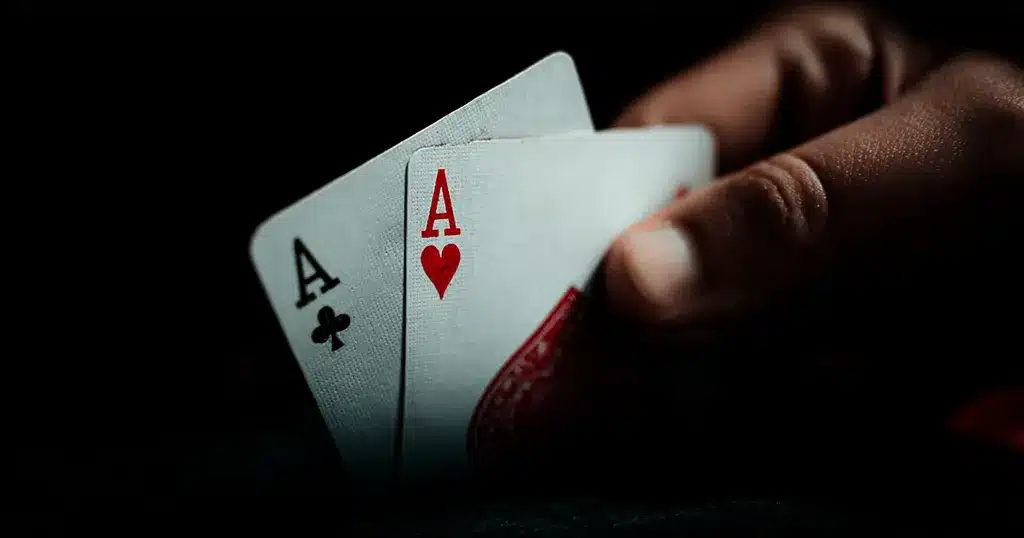
- AK vs JJ: In this classic confrontation, the player holding Ace-King (unsuited) faces off against another wielding a pair of Jacks. Statistically, the Jacks hold a slight advantage with approximately 57% win odds compared to the 43% for the Ace-King. Despite AK’s high potential, JJ is favored due to its made-hand status at the start.
- AQs vs 99: Ace-Queen suited against a pair of Nines. The suited cards add flush potential and a few extra outs, but the made pair still leads, 52% to 47%. The flush helps without flipping the favorite.
- A10s vs 33: Ace-Ten suited against a pair of Threes, about as even as it gets. A10s holds a razor-thin edge at 50.09% to 49.39%, with the remaining 0.52% going to a tie. This is a true flip; the board decides it.
Playing Around the Flip
There is not much to do once the chips are in. Everything that matters happens before that:
- Be the one applying pressure: If you are going to be in a flip, it is better to be the player moving all-in than the player calling. Pushing gives you fold equity — the chance your opponent folds and you win without a flip at all. Calling gives you none; you only win by holding up.
- Know a real flip from a trap: A dominated hand shares a card with a stronger one and is drawing far thinner than it looks. AQ against AK is the classic example — it feels like a flip but it is closer to 25/75. Folding those spots is not weakness; it is the difference between gambling on a coin flip and gambling on a loss.
- Let the situation decide: Whether a flip is worth taking depends on the format. Deep in a tournament, risking your stack on a 50/50 early is rarely worth it; short-stacked or near the bubble, it often is. In a cash game there is no bubble — a flip for stacks is just a thin edge you are choosing to gamble on, and you can reload. Match the risk to the spot, not to the adrenaline.
Coin Flips at the WSOP
Two WSOP Main Event hands show how often a title comes down to a flip:
- Joe McKeehen’s Dominant WSOP Performance: In the 2015 Main Event heads-up, Beckley moved all in with a pair of fours (4♦4♣), and McKeehen called with Ace-Ten (A♥10♦). This setup is a classic “coin-flip” scenario: Beckley with a small pair and McKeehen with two overcards. The board ran out Q♠10♣5♠5♦J♣, ultimately favoring McKeehen with a pair of tens over Beckley’s fours.
- Martin Jacobson’s Clinching Hand in 2014: The final hand between Martin Jacobson and Felix Stephensen in the 2014 WSOP Main Event is a classic coin flip scenario brought to life. Jacobson, holding 10♥ 10♦, was pitted against Stephensen’s A♥ 9♥. The flop came 10♣9♣3♠, giving Jacobson a set of tens and a substantial lead. The turn was the K♦, and with Stephensen drawing dead, the river was a formality. The 4♣ on the river confirmed Jacobson as the champion, winning the $10 million prize.

What Actually Decides Coin Flips
You cannot win a coin flip with skill once the cards are all-in. That part belongs to the board. The skill is everything that comes before: telling a real flip from a dominated trap, applying pressure instead of calling it off, and picking the flips where the math and the situation are both on your side. Take the good ones, pass on the bad ones, and over enough hands the variance evens out in your favor. The flip is never the part you control. Choosing whether to be in it always is.
👉 Use Referral Code: WINBIG 👈DEAL ME IN!
About the Author: Maury Orton is a poker writer and editor contributing to GGPoker. He focuses on clear, reliable explanations of the game, drawing on years of experience in online poker media and digital publishing.