
Casinos Explored: Six Iconic Casinos Every Poker Player Should Know
Some buildings are just buildings. Then there are ones people cross oceans to photograph.
The great casinos are cathedrals of chance, and the house, patient as ever, tends to win in the end. Six of them, spread across four centuries and two continents, trace how gambling grew from a single Venetian room into a global industry.
We start in Monaco.
Monte Carlo: Breaking the Bank
Year-round, tourists stop to photograph one building in Monaco, most with no intention of stepping inside. It’s the Casino de Monte-Carlo, and it’s the reason a principality smaller than Central Park became one of the world’s gambling meccas.
It almost never happened. In the mid-1800s Monaco was broke, its royals taxing citizens who could no longer pay. Salvation arrived as François Blanc, a French operator with a showman’s instinct. Whenever a gambler cleaned out a table, Blanc would drape it in black cloth, send attendants to haul fresh cash up from the vaults, and let the crowd watch the bank refill in real time. The implication was irresistible: here is a place where you can win it all.
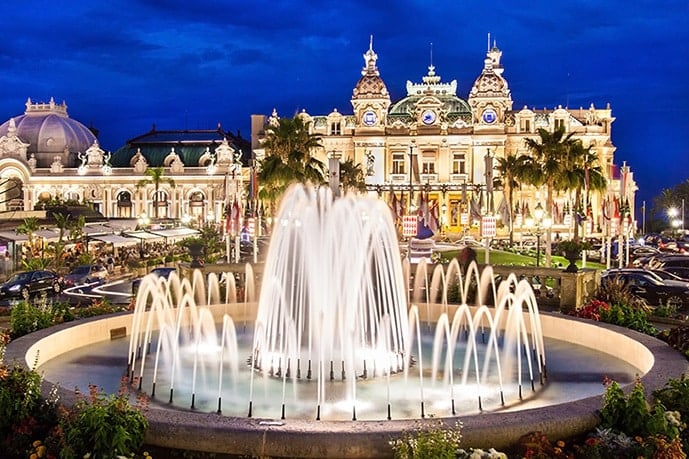
They believed him. Blanc took over in 1863, renamed the district Monte Carlo in the prince’s honor, and made the casino so profitable that Monaco abolished income tax for its citizens, a policy that still holds today.
Then came the summer of 1891, when an Englishman named Charles Wells sat down at the roulette wheel and simply refused to lose. Over a few days he broke the bank again and again, emptying table after table of its reserve, and walked away with a fortune. Nobody ever established how. Luck, system, or fraud, the mystery only fed the legend, and earned him a music-hall song, “The Man Who Broke the Bank at Monte Carlo,” that would be sung for the next fifty years.
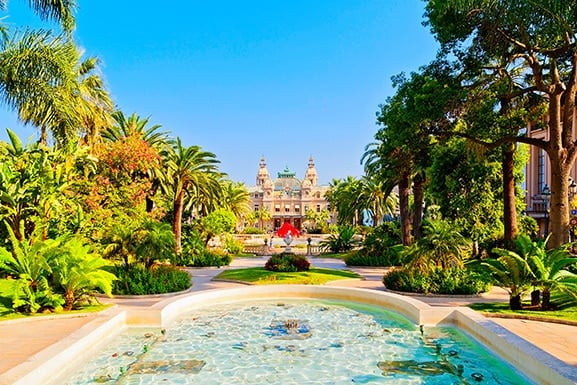
The house endured, as it always does. Monte Carlo still trades on its Belle Époque splendor, and still turns up whenever James Bond needs a table. For poker players it became a pilgrimage of its own: for more than a decade the European Poker Tour closed its season here with the Grand Final, the continent’s finest gathered under one roof. One group stays barred from the floor entirely, the Monégasque themselves, kept from gambling at home since Prince Charles III decided the locals’ money was better off in their own pockets.
Casino di Venezia: The Oldest Game in the World
Ask most people to name the world’s oldest casino and they’ll guess a Vegas titan, or perhaps Monte Carlo. They’d be off by centuries.
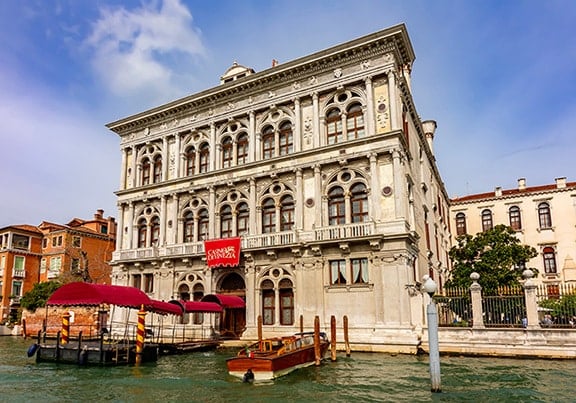
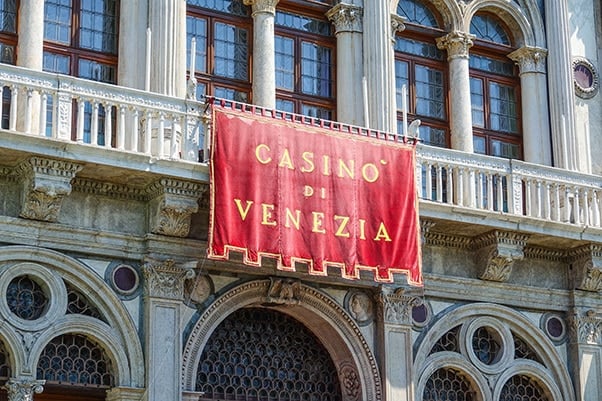
The honor belongs to Venice, which is fitting, since “casino” is an Italian word to begin with, a diminutive of casa, meaning house. In 1638 the Venetian state opened Il Ridotto in a wing of the Palazzo Dandolo, a public gaming room where masked nobles wagered between the acts of the theater next door. It was the first establishment of its kind in the Western world, and the Casino di Venezia traces its lineage to that room, which makes it, by its own reckoning, the oldest gaming house on earth.
The Republic had second thoughts. In 1774 its rulers, alarmed at the fortunes and reputations dissolving at the tables, shut the Ridotto down, and legal gambling in Venice went dark for the better part of two centuries.
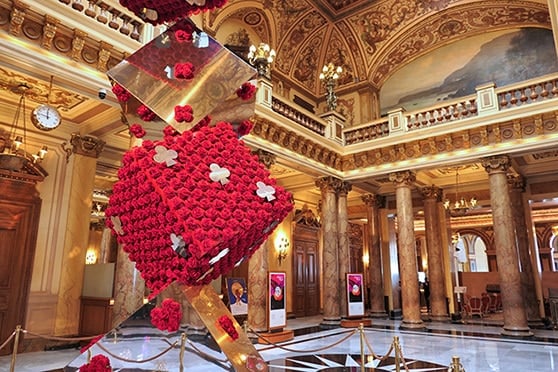
When it finally returned, it found a grander home. Since the 1950s the casino has occupied Ca’ Vendramin Calergi, a Renaissance palace on the Grand Canal so seductive that the composer Richard Wagner chose to live out his last years there, dying within its walls in 1883. Its frescoed halls still deal cards three floors above the water, and the modern game visits too: the palace hosted a World Poker Tour event in 2012, a felt table laid out beneath centuries of gilt and marble.
Then we cross the Atlantic, where the casino stopped being a building and became a spectacle.
The Mirage: The House That Reinvented Vegas
By the late 1980s Las Vegas was fading. A recession had gutted tourism, Atlantic City was stealing its thunder, and the Strip felt tired. Then Steve Wynn bet everything on a volcano.
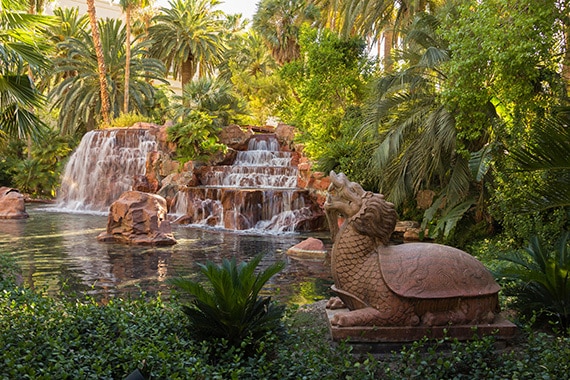
The Mirage opened in 1989 as the most expensive hotel ever built, a $630 million tropical fever dream with a volcano erupting out front, a dolphin habitat, and Siegfried and Roy’s white tigers prowling behind glass. It was the first modern megaresort. Wynn’s obsession was the guest: the hotel’s Y-shape shortened the walk to every room, and a rainforest atrium greeted arrivals before they reached the front desk.
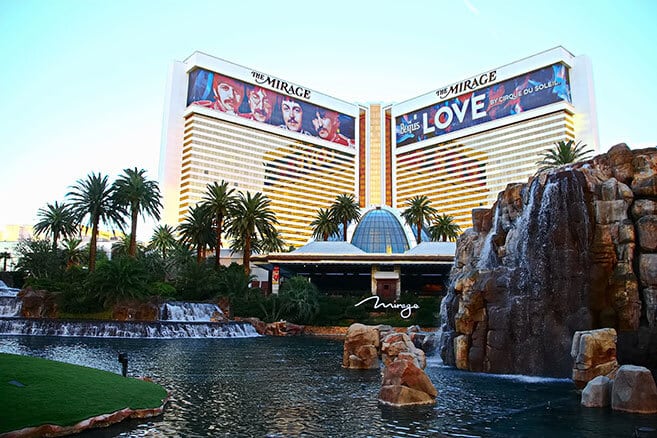
It worked so well it became a template. Every themed colossus that followed owes the Mirage a debt, including the one Wynn would build next door a decade later. (Hold that thought.)
He also ran the place on a then-radical theory: that happy staff make happy guests. The Mirage went ten years without a single union grievance, in an era when Vegas casinos churned through half their workforce a year.
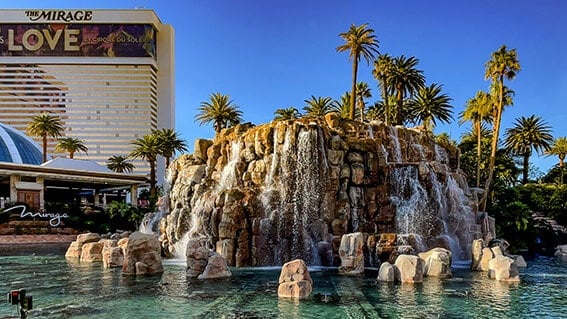
The volcano is dark now. In July 2024, after nearly thirty-five years, the Mirage closed for good, and Hard Rock International, which had bought it the year before, began rebuilding the property around a guitar-shaped tower set to reopen as Hard Rock Las Vegas. The Mirage’s real legacy needs no monument: it proved a casino didn’t have to be a place to lose money. It could be a destination.
MGM Grand: Fire and Rebirth
No casino on this list has died and come back quite like the MGM Grand. It has managed it more than once.
The first MGM Grand opened in 1973, the largest hotel on the Strip, all marble and chandeliers. Seven years later it became the site of one of the worst tragedies in Nevada history. On the morning of November 21, 1980, an electrical fault in the wall of a ground-floor deli sparked a fire that tore through a building with no sprinklers in its casino or guest floors, killing 85 people, most of them overcome by smoke. It remains one of the deadliest hotel fires in modern American history, and it forced a wholesale rewrite of the state’s fire-safety laws. That original building later became Bally’s, and then Horseshoe Las Vegas, which in 2022 hosted the World Series of Poker’s first-ever running on the Strip itself.
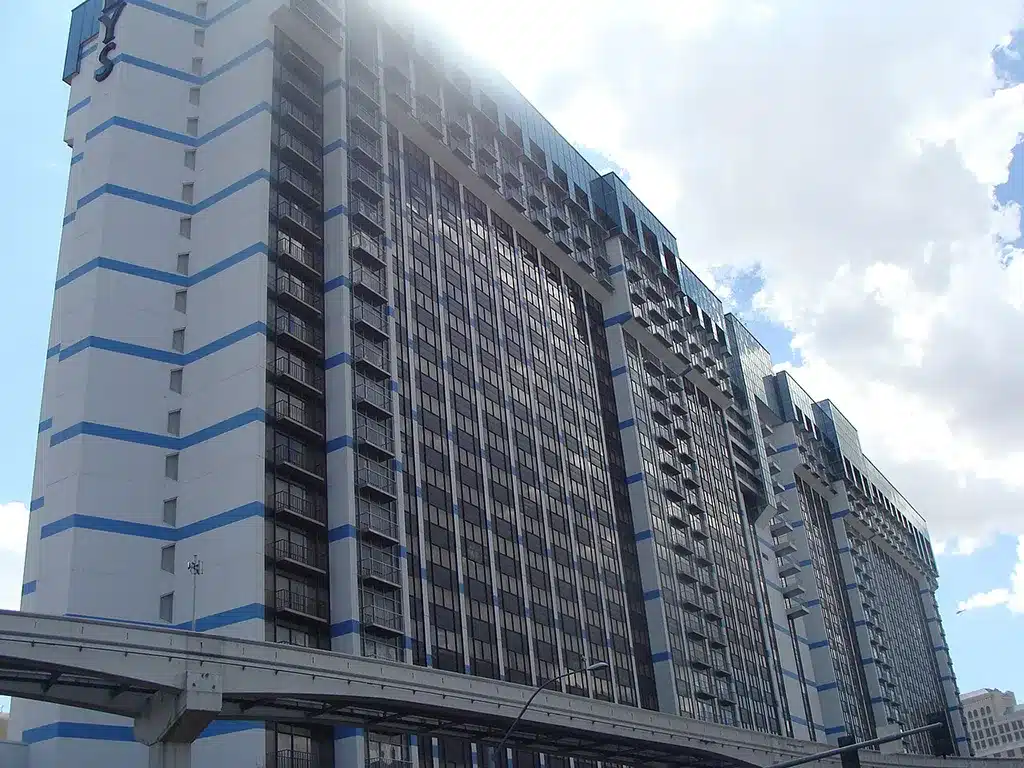
The MGM Grand name, meanwhile, was reborn a few blocks south. The new resort opened in 1993 wrapped in an Emerald City theme, complete with a yellow brick road and a lion’s-mouth entrance guests walked through, until superstition and second thoughts saw the jaws swapped for a more dignified golden lion out front.
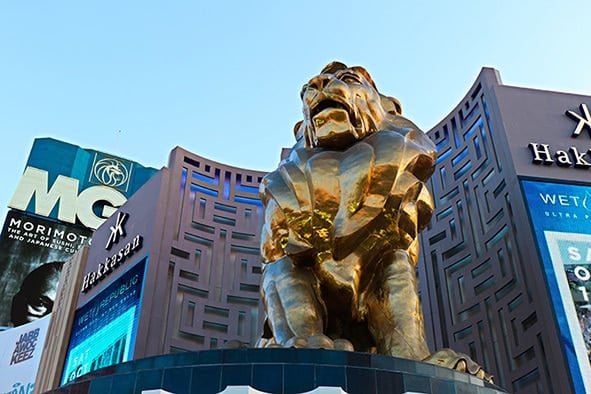
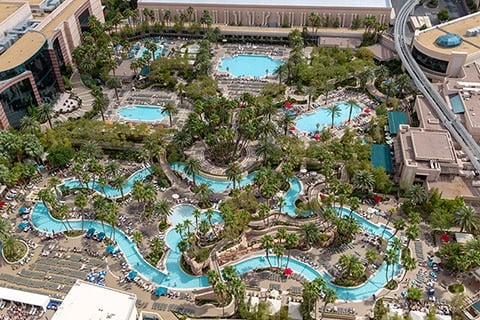
Today its gaming floor runs to more than 170,000 square feet, among the largest on the Strip. It is a monument to the enduring Vegas instinct: build big, then build bigger.
The Stardust: The Mob’s Cathedral
Every list of legends needs a ghost. The Stardust is ours.
It was the dream of Tony Cornero, an ex-bootlegger who wanted a casino for the middle class rather than the high roller. He never saw it open. In 1955, with the Stardust barely three-quarters built, Cornero collapsed and died of a heart attack at a craps table at the Desert Inn, reportedly in the middle of an argument over a $25 chip. Others finished the job, backed by money that didn’t ask many questions, and in 1958 the doors opened beneath a neon sign 216 feet wide and visible from three miles off, the largest on the Strip.
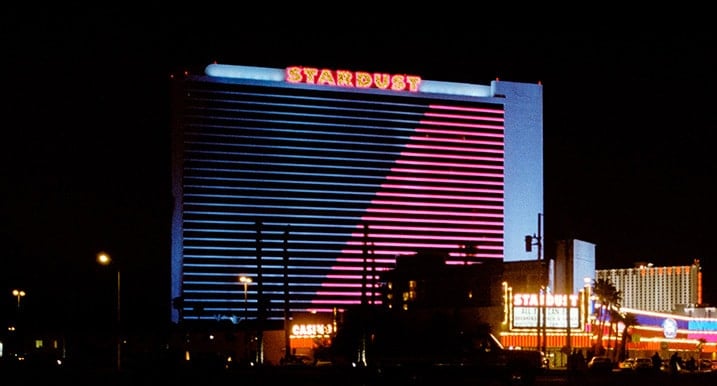
For a while it was glorious. Rooms went for six dollars a night, the Lido de Paris revue played overhead, Muhammad Ali trained on the grounds, and Siegfried and Roy got their start on its stage.
Then there was the other business. Under the Argent Corporation, the Stardust was run by Frank “Lefty” Rosenthal, who skimmed millions in untaxed cash straight off the count and funneled it to the Midwest mob. It’s the story Martin Scorsese would turn into Casino. In 1983 a federal grand jury indicted fifteen people, Nevada pulled the license, and the party was over.
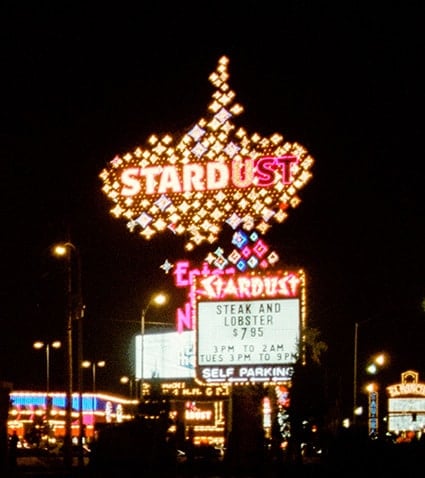
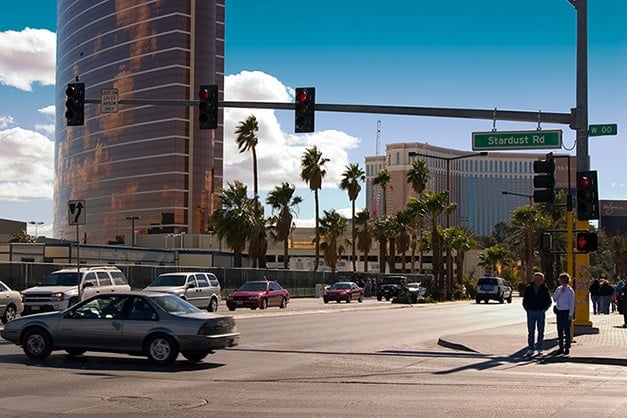
The building outlasted the mob by two decades, until Boyd Gaming closed it in 2006 and the customers filed out in a conga line. Months later it was imploded in a ceremonial cloud of dust, clearing the ground for what is now Resorts World. Its record-breaking neon sign found a final home in the boneyard of the Neon Museum, dark, but not forgotten.
The Bellagio: Where the Legends Play
Steve Wynn wasn’t finished. In 1998, on the ground where the Dunes had stood until its implosion five years earlier, he opened the Bellagio, and at $1.6 billion it was the most expensive hotel ever built.
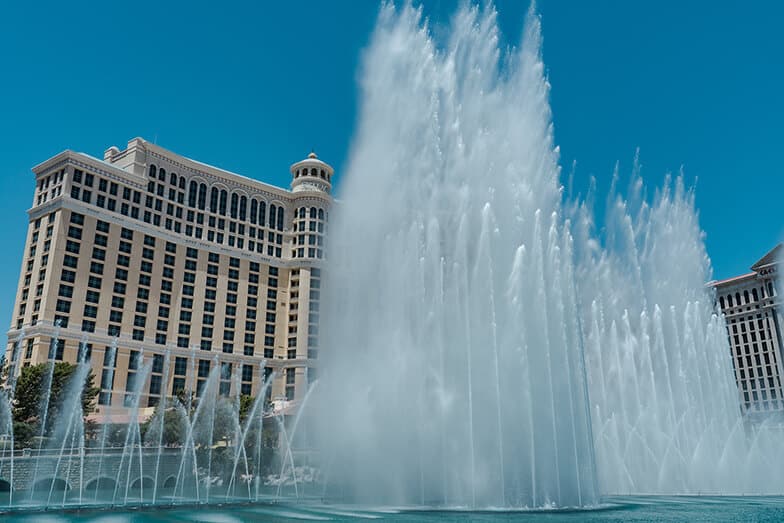
You know what it looks like even if you’ve never been. The fountains, more than a thousand nozzles dancing to music across a man-made lake, are the most filmed sight in Las Vegas. And in 2001, a gang of movie-star thieves robbed its vault in Ocean’s Eleven, sealing the Bellagio’s place in the popular imagination for good.
But for poker players, the Bellagio means one room.
Behind a rope at the back of the poker room sits Bobby’s Room, since renamed the Legends Room, long home to the highest-stakes cash game in the world. Its regulars have included Doyle Brunson, Phil Ivey, and Jennifer Harman. It was here, between 2001 and 2004, that a Texas banker named Andy Beal challenged a syndicate of the world’s best players, “The Corporation,” to the richest heads-up games ever played, with limits climbing toward $100,000 a bet. The pros had to pool their bankrolls just to survive him. Their war is immortalized in the book The Professor, the Banker, and the Suicide King.
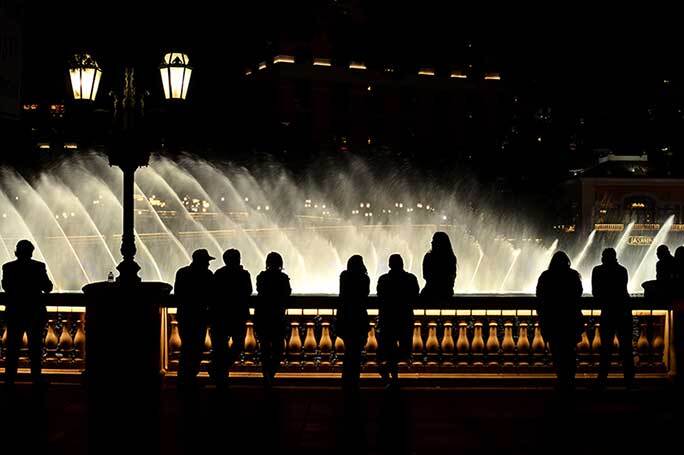
The room’s reach went well beyond that table. It was here the modern tournament era took shape: the very first World Poker Tour event, the Five Diamond World Poker Classic, was dealt at the Bellagio in 2002, and for the next two decades it remained one of the tour’s defining stops.
Cross an ocean from the marble of Monte Carlo, and centuries from the frescoes of Venice, and it still comes down to this: a quiet room, a door that locks, and a few players willing to risk everything on the turn of a card.
Six buildings, four centuries, one enduring bargain between luck and architecture. The marble outlasts the winners and the losers alike. Few of us will ever take a seat in the Legends Room or a Monte Carlo salon, but the game those places were built around has outlasted the buildings themselves, played now around the clock at rooms like GGPoker, open to anyone willing to be dealt in. And somewhere, right now, a dealer is shuffling, a river card is waiting to fall, and someone is certain that tonight is the night they break the bank.
👉 Use Referral Code: WINBIG 👈Play Now
About the Author: Shawn Altbaum has been writing and editing in the online gaming industry since 2007, reporting live from the WSOP Main Event and conducting interviews with professional players. An active poker player, he combines industry expertise with firsthand knowledge of the games he covers. He currently serves as Global Head of Copywriting at NSUS Group, overseeing brand voice and content strategy across GGPoker.