
The Beginners Guide Series: Expected Value (EV)

Play poker long enough and you will hear someone at the table talk about EV. Usually it arrives right after a bad beat, delivered with the weary confidence of a player insisting they were “way ahead.” They are not wrong, and the concept they are leaning on is the single most important idea in serious poker. Expected Value is what separates the players who grind out a profit over years from the ones who chase individual pots and wonder where their money went.
The good news is that it is far simpler than it sounds.
What Expected Value Actually Means
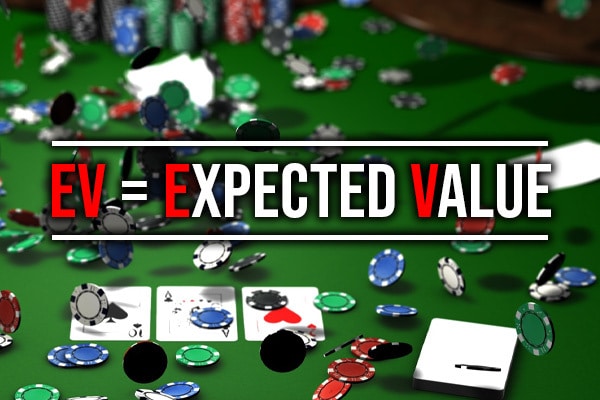
Expected Value, or EV, is the average result of a decision if you made it over and over, forever. That is the whole idea. A single hand tells you almost nothing, because short-term luck drowns out everything else. Play that same spot ten thousand times and the noise falls away, leaving only the true value of the decision underneath.
This is why good players talk about the long run the way they do. They are not being philosophical. They have simply learned to judge a decision by its EV, not by whether this particular hand happened to win.
Start With a Coin
Forget cards for a moment. You and a friend flip a coin, and each flip pays the winner a dollar. Heads you win, tails they do. Over enough flips you each win half the time, so the money washes out. The EV of that bet is zero. Nobody is getting rich, nobody is going broke.
Now change one number. You still win a dollar on heads, but you lose two dollars on tails. Every two flips, on average, you collect a dollar and pay out two. That is a net loss of a dollar across two flips, or fifty cents each. Your EV is minus fifty cents, and no amount of good fortune makes it a bet worth taking. That is the entire point of the concept: it tells you, coldly and in advance, whether a decision makes money or loses it.
The Formula
The math behind that coin flip has a simple shape. Multiply what you stand to win by the chance of winning it, do the same for what you stand to lose, and subtract the second from the first.
Say you make a bet on a single die. Your friend pays you thirty dollars if it lands on a three, and you pay him five dollars if it lands on anything else. A three shows up one time in six, everything else five times in six. Your gain works out to thirty times one-sixth, or five dollars. Your loss is five times five-sixths, a little over four. Subtract, and you are left with an EV of roughly plus eighty-three cents per roll. The die will still land on four when you least want it to, but take that bet a thousand times and you walk away ahead.

Aces Against Kings
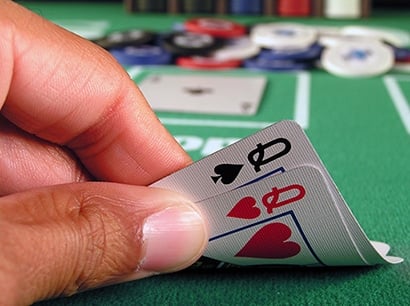
Now the cards. You look down at pocket aces, get it all in before the flop, and run into pocket kings. It is the dream, and the math backs up the feeling. Aces beat kings roughly 81% of the time in that spot.
Say you both have fifty dollars in front of you, so the pot is a hundred. Your equity in that pot is 81% of a hundred dollars, which is eighty-one. You put in fifty to get there, so on average that all-in makes you thirty-one dollars every time you find it. Line that same situation up a hundred times and the math becomes almost boring in its consistency: you would expect to finish around three thousand one hundred dollars ahead. The trick, of course, is finding someone willing to keep stacking off with the worse hand.
When the Decision Is Not So Obvious
Aces versus kings is easy because the money is already in the middle. Most poker decisions are messier, and EV has to account for the chance your opponent folds as well as the chance you win when they call.
Say you have a flush and straight draw on the turn against a single opponent you have pegged as loose. You can shove, and three things can happen. They fold and you take the pot right there. They call and you hit one of your draws by the river. Or they call and you miss. Each branch has its own probability and its own payoff, and EV is just the sum of all three weighted together. Run those numbers on a spot like that and a shove that looks reckless can turn out clearly profitable, carried by the times your opponent folds plus the times you get there.
You will also notice that this is real work. That is the honest catch with EV in the moment: it is far harder to calculate on the fly than pot odds, and nobody expects you to. Its real home is away from the table, where you review the hands you were unsure about and confirm whether the decision was sound. GGPoker’s EV Cashout feature leans on the same idea, letting you take the expected value of an all-in rather than gambling on the actual river.

When the Math Seems to Lie
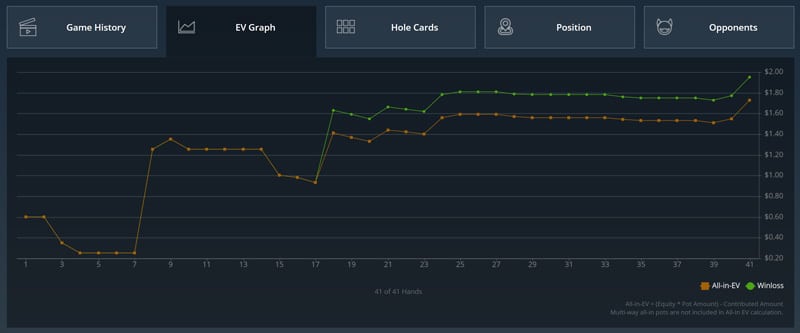
Here is where new players lose faith. You get your aces in as an 81% favorite, and you lose. Then you lose again. That is not the math failing you. That is variance, the gap between what should happen and what actually does over a small sample.
Flip a coin ten times and it will not politely land on five heads and five tails. Seven and three is common. Push the sample to a thousand flips and it drifts back toward even, because variance shrinks as the sample grows. Poker works exactly the same way. An 81% hand will lose almost one time in five, and stringing a few of those together in an evening feels like a personal insult. It is not evidence the site is rigged or your opponent cheated. It is the short term doing what the short term does.
The players who last are the ones who keep making the +EV decision through those stretches, trusting the math to reassert itself over the thousands of hands still to come.
Why It Is Worth the Trouble
Expected Value will never tell you whether you win the hand in front of you. No one can. What it tells you is whether the decision was right, and that is the only thing you actually control at a poker table. Stack up enough right decisions and the results follow, however ugly any single session looks along the way.
Chase the pot and you are gambling. Chase the EV and you are playing poker.


👉 Use Referral Code: WINBIG 👈PLAY NOW!
About the Author: Shawn Altbaum has been writing and editing in the online gaming industry since 2007, reporting live from the WSOP Main Event and conducting interviews with professional players. An active poker player, he combines industry expertise with firsthand knowledge of the games he covers. He currently serves as Global Head of Copywriting at NSUS Group, overseeing brand voice and content strategy across GGPoker.