
The Founding Mothers: Jennifer Harman, Barbara Enright and Linda Johnson
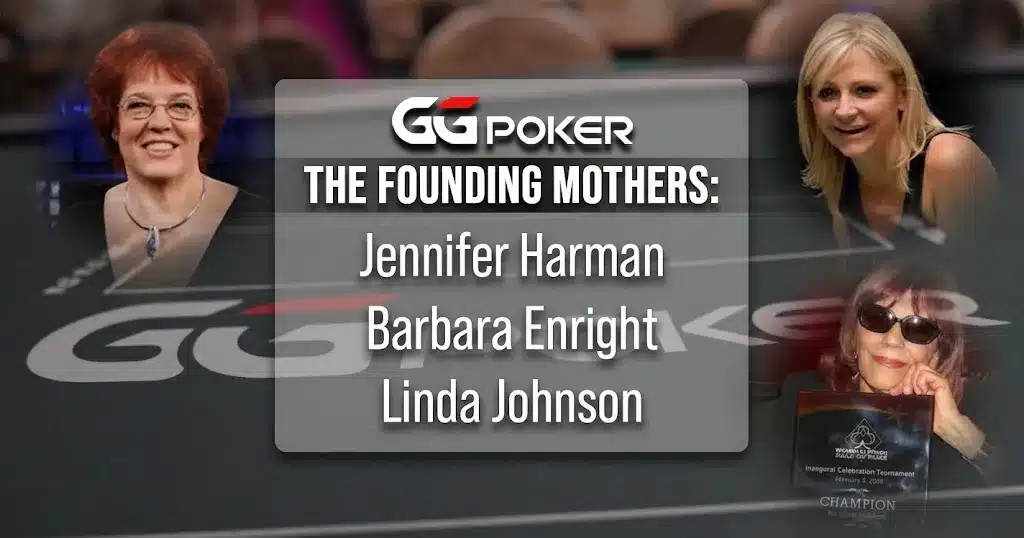
Poker has never been an even room. Since the first World Series of Poker in 1970, the game has run close to eight men for every woman, and for most of that history the highest seats were understood to be men’s seats. The three women here did not wait for that to change. They walked into the biggest cash game in the world, the toughest tournament on the planet, and the rooms where the game’s rules and business were being written, and in each one, they proved a woman belonged. Then they held the door open for everyone who came after.
Jennifer Harman, the One in Bobby’s Room

Jennifer Harman was born in Reno, Nevada, on November 29, 1964, and learned the game watching her father’s weekly home game before talking him into teaching her. The student passed the teacher fast. She went on to earn a biology degree at the University of Nevada, then chose the felt over the lab coat, and it is hard to argue she got the decision wrong.
Her tournament record alone would make the case: two WSOP bracelets, both in open events, one of only a handful of women ever to manage that. The first, a 2000 No-Limit Deuce to Seven Lowball title, is the stuff of legend, since she had never played the game before and took a five-minute crash course from Howard Lederer on the way to the table. The second came in 2002 in $5,000 Limit Hold’em. She final-tabled the World Poker Tour twice and banked her largest score, $383,840, at the 2005 Rio Las Vegas Poker Festival.

But the tournaments were never really the point with Harman. She is the only woman who has been a regular in Bobby’s Room at the Bellagio, the private high-stakes game where the blinds run from $800/$1,600 up to $4,000/$8,000, sitting with the likes of Phil Ivey in the biggest cash games in America, including the famous stretch when a team of pros took on billionaire Andy Beal. Away from the table, two kidney transplants shaped a life built around organ-donation advocacy and the charity she founded, Creating Organ Donor Awareness. The Poker Hall of Fame recognized all of it in 2015.

Barbara Enright, the One at the Final Table

Barbara Enright played cards with her older brother as a small child and never really stopped. She worked as a hairstylist, a bartender, and a cocktail waitress before admitting that her part-time poker was outearning all of it, and she turned pro in the 1970s, a time when a woman doing so was close to unheard of.
What she did next reset the ceiling. Enright won three WSOP bracelets, two in Women’s Seven-Card Stud in 1986 and 1994, and then, in 1996, the Pot-Limit Hold’em event, becoming the first woman ever to win a bracelet in an open field. A year earlier she had done something no woman has done before or since: she reached the final table of the WSOP Main Event, finishing fifth in 1995, the lone woman standing among the giants at poker’s biggest table. She edited Woman Poker Player magazine and championed the women’s game for decades, and in 2007 she became the first woman inducted into the Poker Hall of Fame. She holds places in the Women in Poker and Senior halls of fame as well, a spread of honors almost no one else can claim.

Linda Johnson, the First Lady of Poker

Linda Johnson was born on Long Island, New York, on October 14, 1953, and was working for the United States Postal Service when poker pulled her away for good. She started playing seriously in 1974, and in 1997 she won a WSOP bracelet in $1,500 Seven-Card Razz, becoming the second woman ever to win an open-event bracelet, one year after Enright became the first. The symmetry is fitting, because the two would go into the inaugural Women in Poker Hall of Fame class together in 2008.

Her nickname, “The First Lady of Poker,” was given to her by Mike Sexton, and it was earned less at the tables than around them. Johnson bought Card Player Magazine in 1993 and ran it as publisher, helped found the Tournament Directors Association that standardized the rules the World Poker Tour and WSOP still lean on, was a founding member of the WPT and its broadcast announcer for six seasons, and later co-founded the charity PokerGives. If Harman proved a woman could win the biggest cash game and Enright proved a woman could win the biggest tournament, Johnson proved a woman could build the machinery the whole game runs on. The Poker Hall of Fame inducted her in 2011, the second woman to be honored, four years after the first.
The Door They Held Open
It is easy now to watch a woman win a super high roller and forget how recently that was close to impossible. Harman, Enright, and Johnson came up when there was no path, so they cut one, each in a different direction: the cash game, the tournament, and the boardroom. Every one of them is in a Hall of Fame, and all three spent as much energy lifting other women into the game as they spent winning at it.
The players who came later, the modern stars who now sit in the biggest games as a matter of course, walked through a door these three pried open and refused to let close. That is the rarest kind of legacy in poker. Not a pot or a title, but a game that finally had room in it for the people who came next.
👉 Use Referral Code: WINBIG 👈PLAY NOW!
About the Author: Shawn Altbaum has been writing and editing in the online gaming industry since 2007, reporting live from the WSOP Main Event and conducting interviews with professional players. An active poker player, he combines industry expertise with firsthand knowledge of the games he covers. He currently serves as Global Head of Copywriting at NSUS Group, overseeing brand voice and content strategy across GGPoker.