
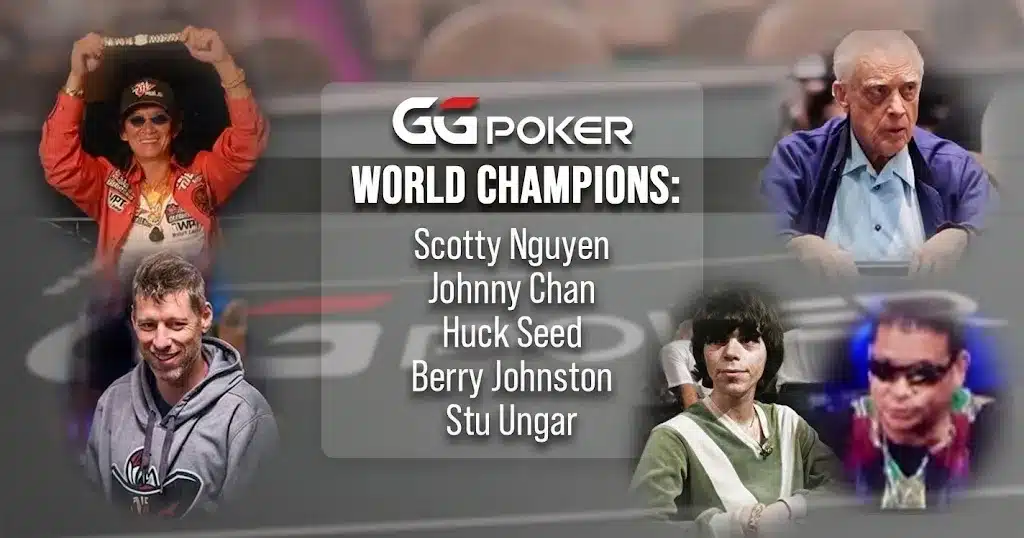
World Champions: Stu Ungar, Johnny Chan, Scotty Nguyen, Huck Seed and Berry Johnston
There was a stretch, from 1980 to the tail end of the 90s, when the entire poker world could still fit inside one smoky room at Binion’s Horseshoe. A few hundred players entered the World Series Main Event, not a few thousand, and to win it you had to get past everyone who mattered, because everyone who mattered was right there in the room with you. This was before satellites and television grew the fields into the thousands and opened the title up to players qualifying online from all over the world. Back then, the champion was, for a year, about as close to king of the whole game as the game allowed.
Here is the strange part. Several of the men who wore that crown could not afford to sit down for it. The very best of them, more than once, needed a friend to spot him the buy-in. Keep that in mind, because it comes back.
Five champions define the era, and no two of them carried the crown the same way. One turned every big pot into theater. One built a dynasty and made it look like paperwork. One was a six-foot-seven eccentric who would bet you he could stand in the ocean overnight. One was so gentle that the hardest players alive adored him. And one, the last we will get to, was simply the finest card player who ever lived, which did nothing to spare him the cruelest ending in the game.
The showman comes first.
👉 Use Referral Code: WINBIG 👈PLAY ONLINE POKER HERE
Scotty Nguyen: The Prince of Poker

Scotty Nguyen earned his nickname the honest way. He turned up to the 2001 World Series draped in so much gold and diamond that “The Prince of Poker” stuck to him on sight and never came off. Born Thuan Nguyen in Nha Trang, Vietnam in 1962, he reached the United States at fourteen and worked out in a hurry that he could beat grown men across a card table. By his early twenties he had done what nearly everyone in this story eventually did, and pointed himself at Las Vegas.
It did not go well at first. He dealt at Harrah’s for around $150 a night and handed most of it back at the stud tables the same evening. He called himself a fish and meant it. Then the wins arrived, he ran a bankroll up to a cool million, spent it about as fast as he made it on a Camaro, a Corvette, and a condo, and went stone broke. In this crowd, going broke was practically a rite of passage.
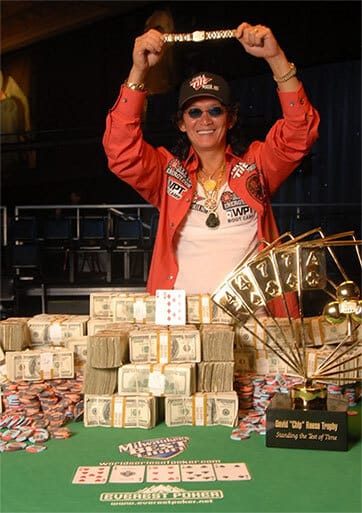
By 1998 he was broke again and could not cover the Main Event entry, so a young Mike Matusow staked him a third of the buy-in. It is one of the great investments in poker history. Scotty ran through the field to the title and a full million dollars, and handed the game one of its immortal lines on the way. Board showing 8-9-9-8-8, he leaned across at Kevin McBride and purred, “You call, it’s gonna be all over, baby.” McBride called, announced “I play the board,” and did not seem to grasp that he was already beaten. Scotty’s J-9 made the better full house, nines full of eights, and a catchphrase entered the language for good.
The celebration did not last a day. The morning after the biggest win of his life, Scotty’s brother was killed in a car accident. He has never worn that bracelet since, out of respect. It is the first hint that the crown in this era came with a bill attached.
He remains, to this day, the only player ever to win both the Main Event and the $50,000 H.O.R.S.E World Championship, now the Poker Players Championship, an event the professionals quietly rate above the Main Event itself. That 2008 win came wrapped in scandal, a boozy, foul-mouthed final table he later apologized for without a single excuse attached. With Scotty the gift and the trouble were always the same trait, just pointed in different directions.
Johnny Chan: The Orient Express
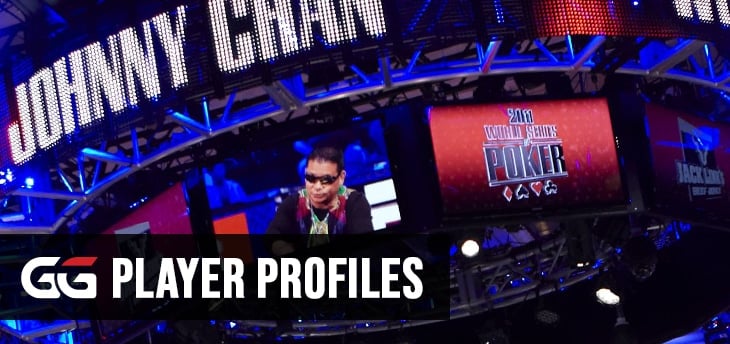
If Scotty was theater, Johnny Chan was inevitability. Born in Guangzhou in 1957 and raised first in Hong Kong and then in Houston, where his family ran a restaurant, Chan learned the game in that restaurant’s back room and got so good they threw him out for winning too much of the house’s money. He was meant to take over the family business. Las Vegas had other ideas.
The casino owner Bob Stupak pinned the nickname on him, “The Orient Express,” after watching him knock out 13 of 16 players in a single half hour. Chan then spent a decade earning it in the only place it counted.
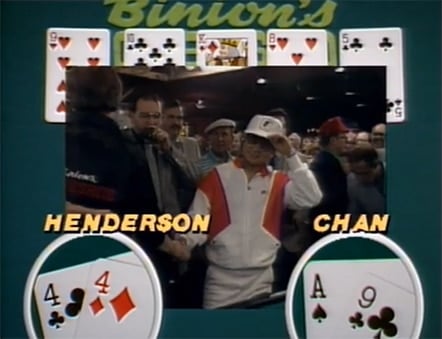
He won the Main Event in 1987, defended it in 1988, and came within a single hand of an unthinkable third straight before a brash young Phil Hellmuth beat him heads-up in 1989. Only a tiny handful of players have ever gone back-to-back. Nobody since has come as close to three in a row.
He would go on to collect ten WSOP bracelets, the first player in history to reach that number, winning them across Texas Hold’em, Seven Card Stud, Deuce to Seven Draw, and Pot Limit Omaha. For good measure, he mentored Jamie Gold to the 2006 title.
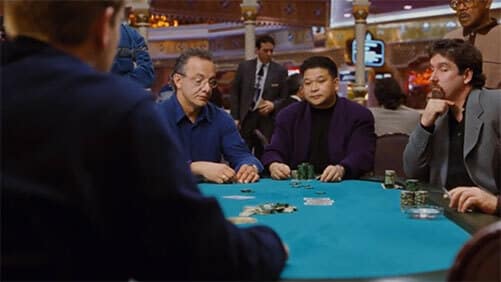
A whole generation who never watched him play a hand still knows his face, because he is the man Matt Damon’s character studies in the film Rounders, the cool, unreadable pro peeling an orange while he quietly takes your stack. That orange began life as an air freshener against the cigarette smoke and ended up his good-luck charm, at his elbow for every session. Doyle Brunson had once dismissed Chan as hot-headed, a kid with talent who did not know when to walk away. The dynasty was Chan’s reply.
Huck Seed: The Giant Who Would Bet on Anything
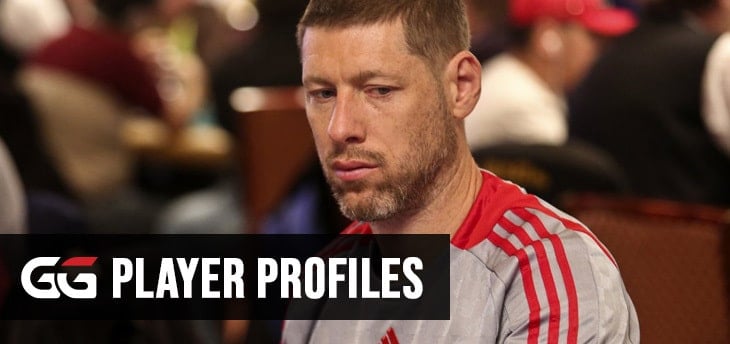
Every golden age needs one player who refuses to fit the mold, and the 1996 champion is that man. Huckleberry “Huck” Seed, all six foot seven of him, came out of Montana, starred on the California Institute of Technology basketball team, and carried the kind of math brain that makes a game like poker look almost solvable. Basketball and engineering were the plan. The felt won the argument.
He took down the Main Event in 1996 for a cool million and had his portrait hung on Binion’s Wall of Champions. His summary of the moment was pure Seed: “Ever watch the Super Bowl? It’s like that.” Four bracelets in three different poker variants followed, along with a Tournament of Champions title.

That spread of bracelets, taken at Razz and Omaha as readily as Hold’em, is the tell. Seed was no specialist who caught fire for one week. He could beat you at any game you cared to name, which is exactly why the toughest mixed-game events would later suit him so well.
But ask anyone about Huck Seed and they skip the bracelets and go straight to the prop bets. He once bet Phil Hellmuth he could stand in the ocean for eighteen hours, and lasted three. He bet he could break 100 on a desert golf course in 120-degree heat using only three clubs, and collected.
And in the most-told wager of all, Howard Lederer bet that a six-foot-seven man could not land a standing backflip. Seed pocketed ten grand and stuck the landing clean. The 2009 National Heads-Up Championship, where he ran through Daniel Negreanu and Sammy Farha for half a million, almost reads as ordinary next to that.
Berry Johnston: The Quietest Man at the Table
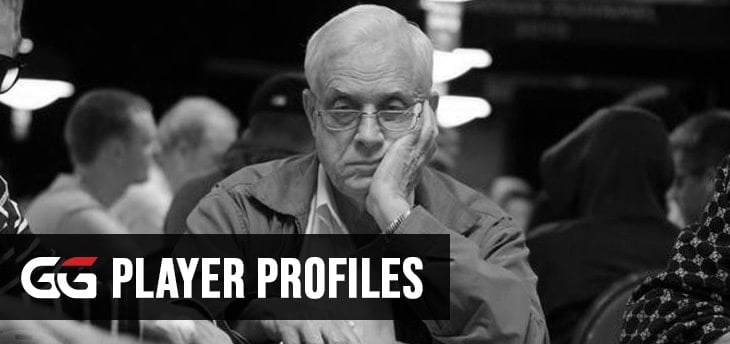
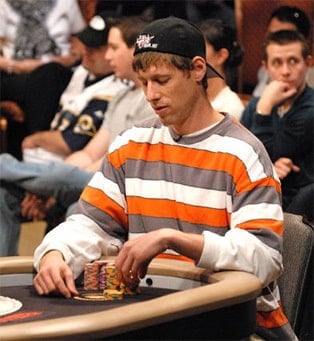
For every Scotty Nguyen the game needs a Berry Johnston, and it was lucky to have both. Where the others announced themselves, Johnston barely raised his voice. Born in Oklahoma in 1935, he did not sit down at a poker table until he was thirty-five, which in this crowd makes him a late starter by a good two decades.
Once he started, he did not stop. He moved to Vegas and held his own in the highest cash games in town against Doyle Brunson and Chip Reese, the same nightly contest that would become famous as the Big Game. Tournament poker, as it turned out, was where he truly shone.
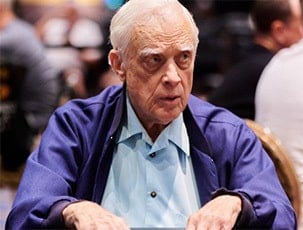
His 1986 Main Event title, worth $570,000, is the headline, taken at a stacked final table with Dewey Tomko among the fallen. But the number that really tells you who he was is a quieter one: he cashed in at least one WSOP event every single year from 1982 to 2010, the longest such streak in the game’s history. Five bracelets, spread across Hold’em, Omaha, and Razz, and ten Main Event cashes, tied with Johnny Chan for the most ever recorded.
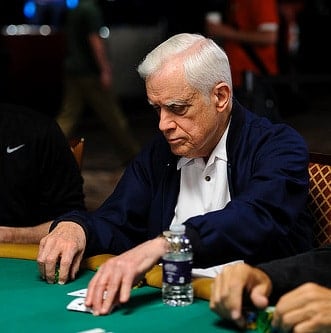
Through every year of it, he made not one enemy. When Johnston entered the Poker Hall of Fame in 2004, Doyle Brunson said the thing everyone in the room already felt: “What I admire most about Berry is not Berry the great poker player, but Berry the man … a gentleman at all times.” Four years on, he took a seat at the Poker After Dark World Champions table beside Phil Hellmuth and Chris Ferguson, finished a tidy fourth, and went home exactly the way he always did, without any fuss at all.
Stu Ungar: The Comeback Kid
Which brings us, at last, to the best of them.
There is a serious case that Stu Ungar was the greatest card player who ever lived, and it does not rest on poker at all. Ungar was a gin rummy prodigy first, so far ahead of the field that a top pro named Harry Stein lost to him 86 games to nothing and quit the game entirely. Casinos begged Stu to stay out of their gin tournaments because his name alone scared off the entries. He had an eidetic memory and counted cards so ruthlessly that he was barred from blackjack in casinos across the country.
“Some day,” he once said, “I suppose it’s possible for someone to be a better No-Limit Hold’em player than me. I doubt it, but it could happen. But I swear to you, I don’t see how anyone could ever play gin better than me.” Poker was almost an afterthought, the game he moved to because nobody would face him at gin anymore.
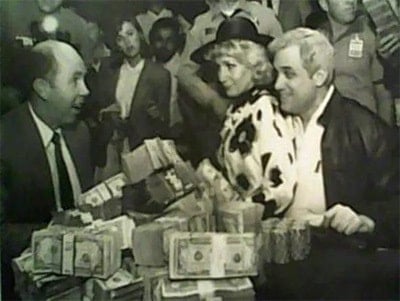
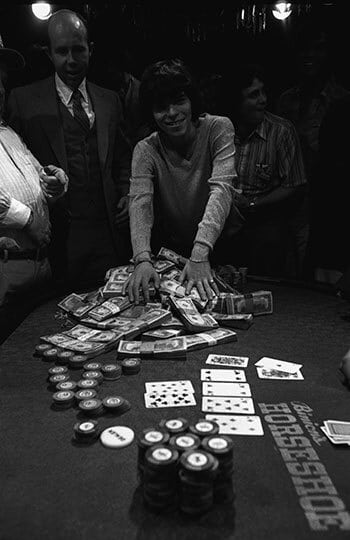
And here the motif returns. In 1980, in only his second poker tournament, Ungar could not put up his own entry, so a gambler named Fred “Sarge” Ferris staked him into the field. Ungar repaid the favor by beating Doyle Brunson to win the Main Event at twenty-six, the youngest champion the game had yet seen. They called him “The Kid.”
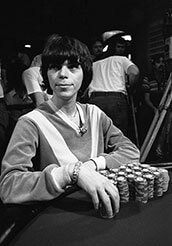
A year later he defended the title, beating Perry Green, though he nearly did not get to play at all. He had been banned from Binion’s Horseshoe for spitting in a dealer’s face, and only made it back to the table because Jack Binion talked his father, Horseshoe founder Benny Binion, into allowing it for the publicity Ungar would draw. Back-to-back titles, the same rare feat Chan would pull off later in the decade, and Ungar had reached it first.
Then the fall. Cocaine took hold in the early 80s and never loosened its grip. In 1990 he was the chip leader deep in the Main Event when an overdose put him in a hospital bed, and he still finished ninth on chips he was in no condition to defend. More than a few of his friends did not expect him to see forty.
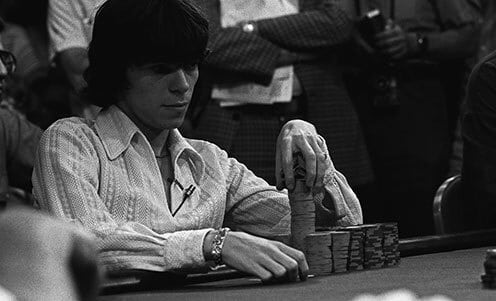
By 1997 he was broke and battered and could not raise his own entry fee, the very same problem he had in 1980. And the very same kind of solution appeared. His friend Billy Baxter pressed $10,000 into his hand at the door. Driven, he said, by thoughts of his daughter Stefanie, Ungar won a third Main Event title, sixteen years after the first two. That is where “The Comeback Kid” comes from, and it stands as the single greatest comeback the game has ever seen.
The crown did not buy him an ending to match. Ungar died the following year, in 1998, at forty-five, alone in a Las Vegas motel room, with almost nothing left of the millions that had flowed through his hands. He is the whole golden age pressed into a single man: the genius, the fame, the spectacle, and the price of every bit of it.
The Crown and the Cost
Notice what quietly binds them. Scotty needed Matusow. Ungar needed Ferris, and then he needed Baxter. In this era the money in a player’s pocket said almost nothing about the player himself, because the man who could not cover his own seat was often the most dangerous person in the room the moment someone spotted him the buy-in. The crown was never about what you brought to the table. It was about what you did once you sat down.
Five champions, five ways to wear it. Scotty made it theater, Chan made it a dynasty, Seed made it a punchline and a legend at the same time, Johnston made it look like good manners, and Ungar made it immortal. They won in a World Series of Poker still small enough to feel human and already big enough to make a man famous overnight.
The room is a great deal bigger now. Thousands chase the same crown these five once wore, most of them online, on a laptop, dreaming of the seat that used to sit at the back of Binion’s. That dream has only grown since, and GGPoker is where the modern version of the story gets written, with satellites feeding the biggest live events in the world and a full schedule of championship poker for anyone ready to sit down and find out what they would do with a stake of their own.
About the Author: Shawn Altbaum has been writing and editing in the online gaming industry since 2007, reporting live from the WSOP Main Event and conducting interviews with professional players. An active poker player, he combines industry expertise with firsthand knowledge of the games he covers. He currently serves as Global Head of Copywriting at NSUS Group, overseeing brand voice and content strategy across GGPoker.